 The Daily
Course Management
 Quick · 1 min Course Management
Tee Up on the Same Side as the Trouble
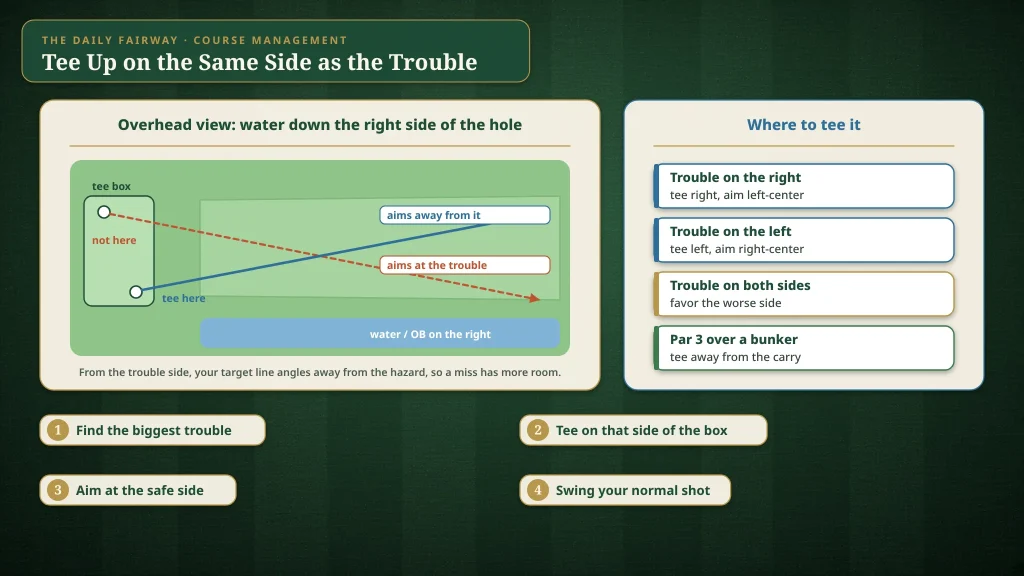
Most golfers stick the tee wherever it's convenient, or tee up as far from the danger as they can. That second instinct feels safe, but it actually points you toward the trouble. Look down the hole before you tee off and find the worst spot to miss, such as water, out of bounds or a deep fairway bunker. Then tee up on that same side of the tee box and aim toward the safe side of the fairway. Grayson Zacker, Director of Instruction for Jim McLean Golf Schools, told GOLF.com that teeing up on the side of danger gives you more room to miss, because your target line now angles away from the hazard instead of back toward it. As he puts it, golf is a game of misses. Golf school owner Mel Sole teaches the same thing: with trouble down the right, tee it up on the right side and aim down the middle or left-center, so even a slightly offline shot to the right still has room. If there's trouble on both sides, pick the worse one and tee on that side. On a par 3 with a bunker guarding one side of the green, tee up on the opposite side so you aren't asked to carry it.
 Quick · 1 min Course Management
Win More Matches With Smart Match Play Strategy
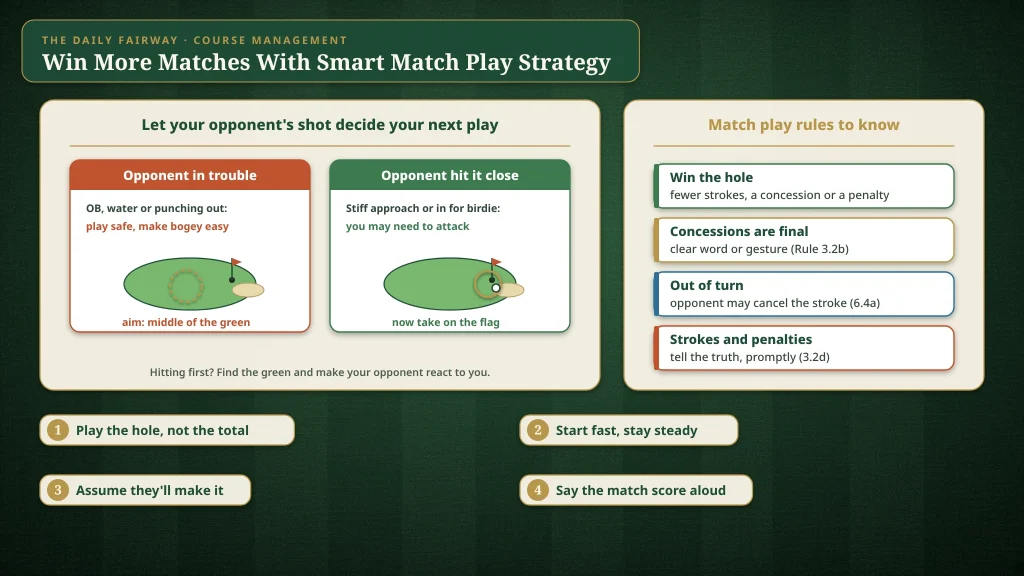
Match play is a different game from stroke play. You're not trying to shoot your best score; you're trying to win more holes than the player in front of you. A triple bogey costs you exactly one hole, the same as a bogey that loses to a par. That changes how you should think about risk, putting and even the rules. Here's how to play smarter in your next club match, member-guest or weekend game with friends.
 Quick · 1 min Course Management
Break 100 With a Bogey Game Plan
Breaking 100 doesn't take a better swing. It takes fewer wasted strokes. If you make bogey on every hole of a par-72 course, you shoot 90, which leaves you 9 spare strokes for double bogeys and still breaks 100. Most players who shoot over 100 lose those strokes in the same few places: penalty shots off the tee, two or three chips around the green, getting stuck in bunkers and three-putts. Tracking company Shot Scope found that golfers who shoot in the 100s average about 8 tee shots in trouble per round, and about 5 or 6 times a round they fail to reach the green with their first shot from inside 70 yards. Here's a simple game plan, built from advice by GOLF.com instructors and veteran teacher Hank Haney, that targets each of those leaks.
 Quick · 1 min Course Management
Adjust Your Yardage for Uphill and Downhill Shots
Your rangefinder or GPS gives you the straight-line number to the flag, but it doesn't tell you how far the shot will actually play when the green sits well above or below you. Golf Digest notes that amateurs who just zap the pin and pull a club miss the green short more than 70 percent of the time, and ignoring elevation is one reason. Uphill shots come down sooner and fly shorter. Downhill shots hang in the air longer and fly farther. Here's a simple way to adjust.
 Quick · 1 min Course Management
Play the Right Set of Tees
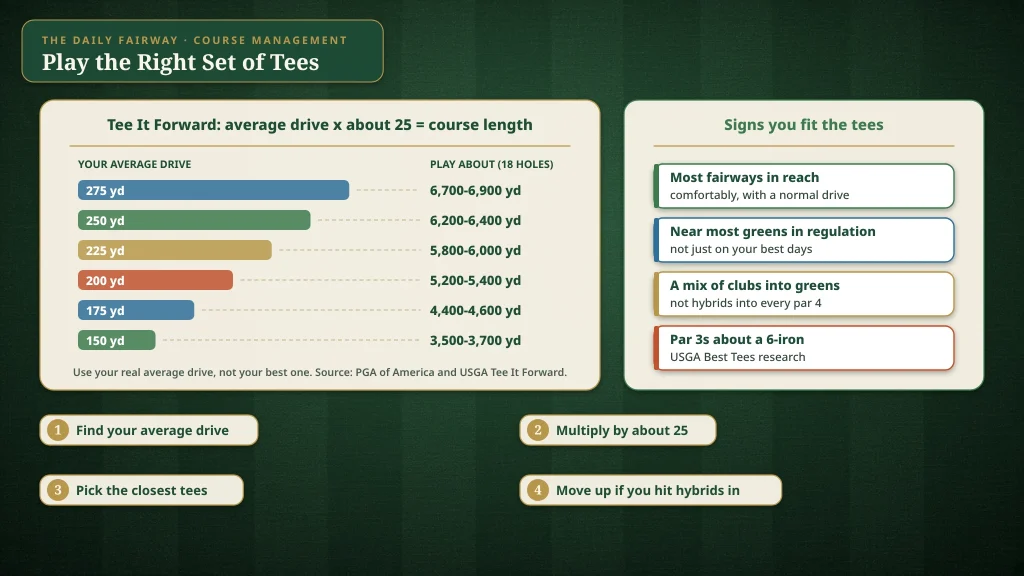
Playing from tees that are too long for you turns every par 4 into a fairway wood approach, and that's no fun for anyone. Pick tees that match your distance, not your ego. The PGA of America and USGA's Tee It Forward guideline is simple: multiply your average drive (not your best one) by about 25 and play the tees closest to that total yardage. If you average 200 yards off the tee, look for a course around 5,200 to 5,400 yards. At 225, that's 5,800 to 6,000. At 250, it's 6,200 to 6,400. The USGA's newer Best Tees research says a set of tees fits when you can reach most fairways comfortably, get near most greens in regulation and hit a mix of clubs into them, with par 3s playing about a 6-iron for you. If you're hitting hybrids into half the par 4s, move up a set. Try it for a few rounds. You'll hit more short irons, make more pars and keep up with the group ahead. Your Handicap Index works from any set of tees, so moving up doesn't cost you anything.
 Quick · 1 min Course Management
Tee It Up on Every Par 3
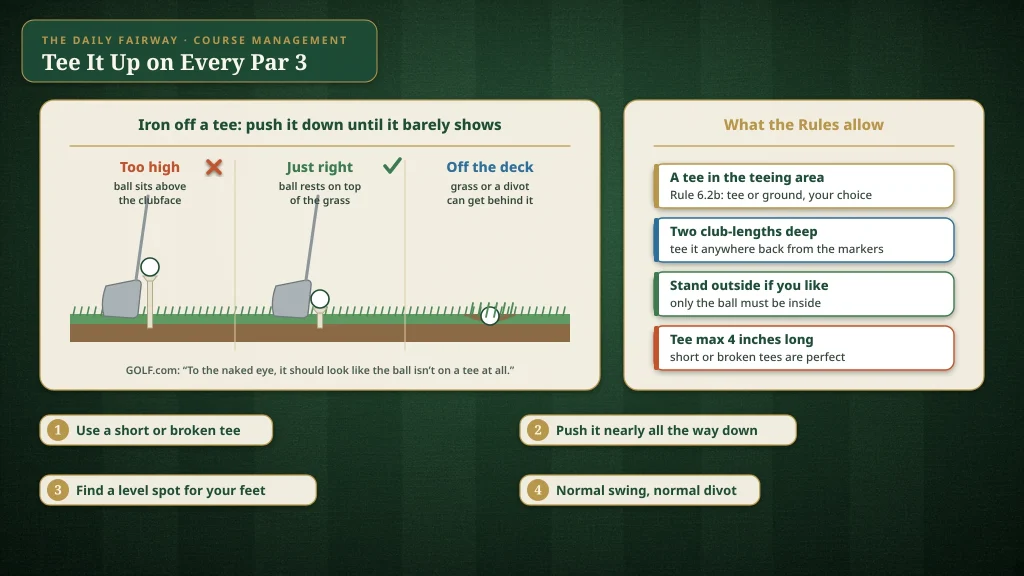
The tee shot on a par 3 is the one iron shot all day where you get to pick your lie, so take it. The Rules let you play from a tee anywhere in the teeing area, which runs two club-lengths back from the front of the markers, and you may even stand outside it as long as the ball is inside. Teeing up an iron doesn't mean teeing it high. GOLF.com's advice is to push the tee almost all the way into the ground, so to the naked eye the ball looks like it isn't on a tee at all, just sitting on top of the grass. That gives you a perfect fairway lie: no grass trapped between the face and the ball, no divot or bare patch, and the ball meets the sweet spot low in the middle of the face. Tee it too high and you risk catching it high on the face, which costs distance and changes the flight. Use a short or broken tee, find a level spot for your feet, then make your normal swing and take your normal divot in front of the tee.
 Quick · 1 min Course Management
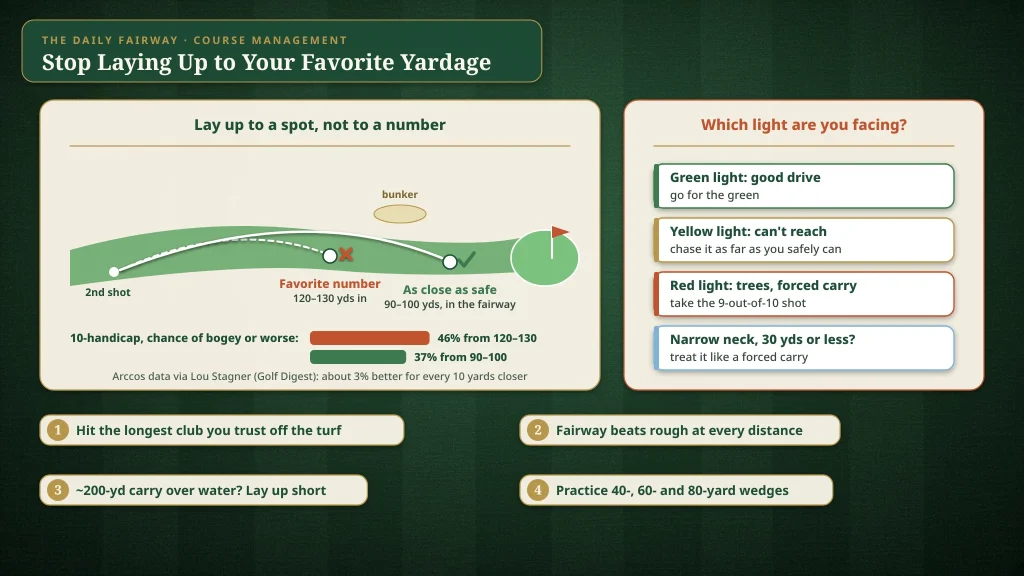
Stop Laying Up to Your Favorite Yardage
On a par 5 you can't reach in two, a lot of golfers pull a comfortable club and lay up to a favorite number, often around 100 yards for a full wedge. It feels smart, but shot-tracking data says it usually costs strokes. When Arccos studied 1.34 million par-5 holes played by more than 18,000 handicapped golfers, scores got steadily worse the farther back players laid up, with no sweet-spot yardage where the trend turned around; laying back from 60 to 100 yards cost about 0.22 strokes. Earlier Arccos data found that every handicap group hit it closer from 60 to 80 yards than from 100 to 120. The rule is simple: lay up to a spot, not to a number.
 Quick · 1 min Course Management
Play Smarter Golf in Cold Weather
Cold-weather golf is a different game. The ball doesn't fly as far, your body is stiffer under extra layers, the ground can be rock hard or soggy, and early tee times may wait on frost. You don't need a new swing. You need new numbers, a warm ball, the right clothes and a more conservative game plan.
 In-Depth · 10 min Course Management
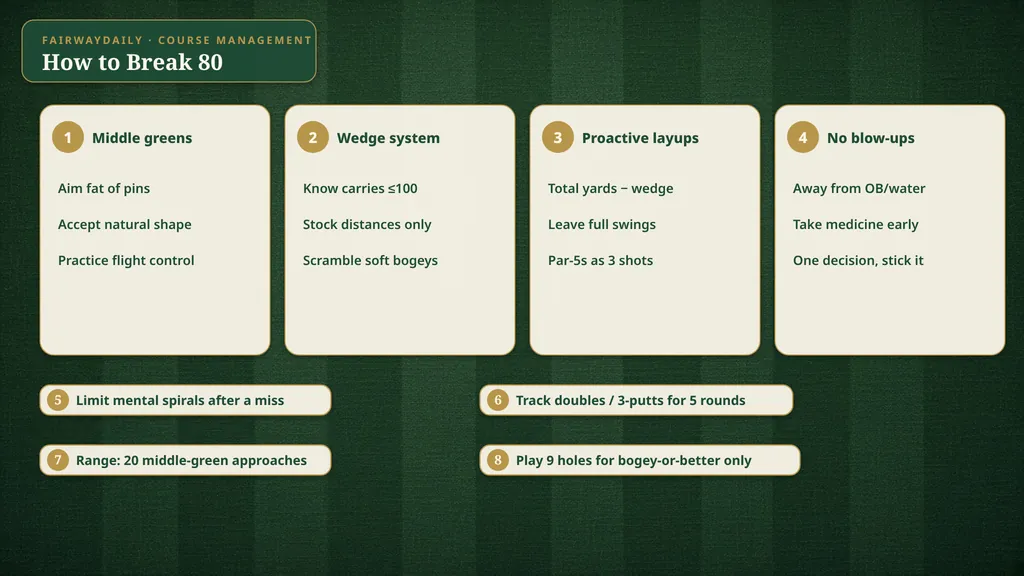
How to Break 80
Breaking 80 is less about a perfect swing and more about cleaning up soft mistakes. You need enough ball-striking to hit greens from mid-irons, but the leap from the mid-80s usually comes from strategy and short-game habits.
 In-Depth · 10 min Course Management
Playing Smart From Trouble
Recovery shots can save strokes if you play smart.