 The Daily
quick
 Quick · 1 min Etiquette
Repair Your Divots
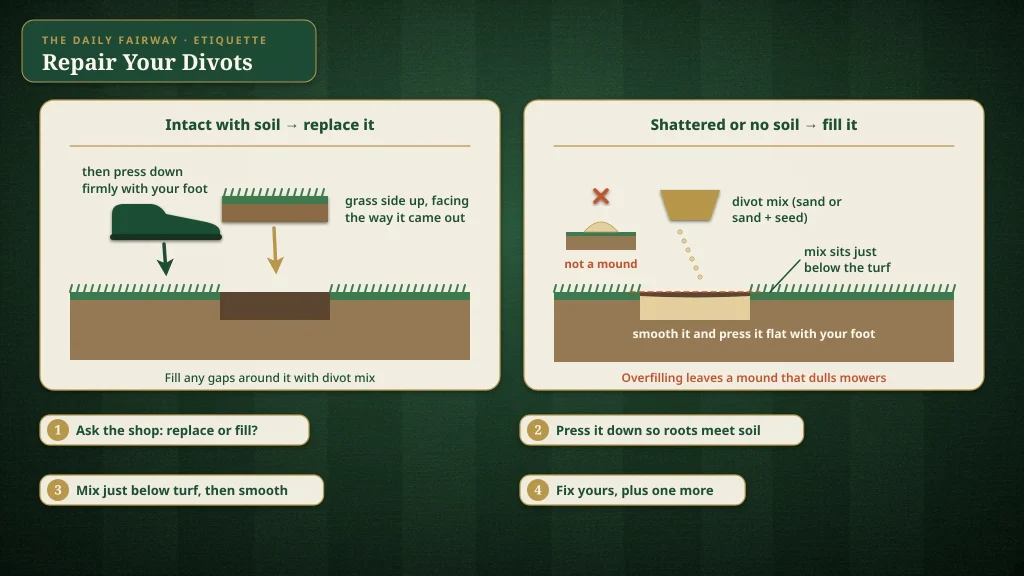
Check how your course wants divots handled, then fix every one you take. If the turf came out in one piece with soil attached, set it back in the hole the right way round and press it down firmly with your foot. If it shattered, fill the hole with the course's divot mix until it sits just below the surrounding grass, then smooth it flat. Fix one more for the next group.
 Quick · 1 min Rules
Play a Provisional Ball
If your tee shot might be lost or out of bounds, announce "provisional" and hit another before walking forward. It saves a walk back if the first ball isn't found within three minutes.
 Quick · 1 min Putting
Use a Line on Your Ball
Draw a line on your ball and aim it at your start line on short putts. Test 10 putts with it and 10 without; keep it only if it helps you commit.
 Quick · 1 min Etiquette
Play Ready Golf
In stroke play, hit when you're ready and it's safe rather than waiting for whoever is farthest away. Shorter hitters go first, hit before helping search, and mark scores at the next tee.
 Quick · 1 min Etiquette
Fix Your Ball Mark
Use a tee or repair tool behind the mark and push the edges toward the center. Don't lift or twist; that tears roots. Tamp it smooth with your putter, then fix one more.
 Quick · 1 min Mental
Forget the Last Shot
Give yourself ten steps to react to a bad shot, then let it go. The next shot only cares about where the ball is now.
 Quick · 1 min Fitness
Stretch Your Hips Before Teeing Off
Do 10 hip circles each way and a few lunges before the first tee. Mobile hips make it easier to turn fully.
 Quick · 1 min Short Game
Pick the Right Chipping Club
Use the least lofted club that will carry the fringe and roll out to the hole. More roll is easier to control than more air.
 Quick · 1 min Fitness
Hydrate on the Front Nine
Drink water before you feel thirsty. Even mild dehydration hurts your focus and distance control on the back nine.
 Quick · 1 min Putting
Lag Putts to a 3-Foot Circle
On long putts, picture a 3-foot circle around the hole and just try to finish inside it. You'll three-putt far less.