 The Daily
Escape a Fried Egg Lie in the Bunker
Disclosure: Some links on this page are affiliate links. If you buy through them we may earn a commission at no extra cost to you. As an Amazon Associate I earn from qualifying purchases. Learn more.
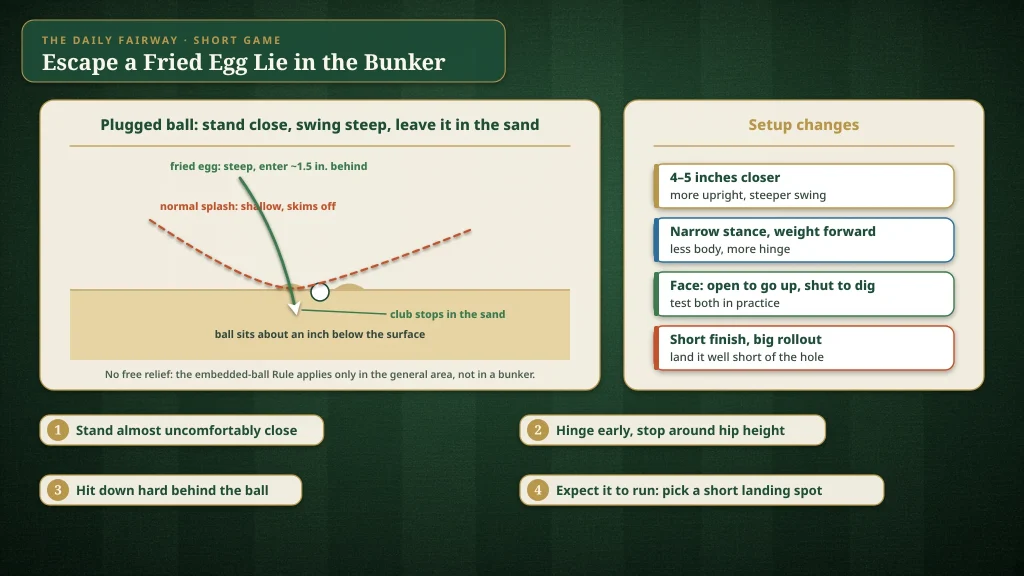
Your ball has plugged in the sand with a crater around it, the classic fried egg. Your normal splash shot won’t work here: the open, shallow swing that skims under a ball sitting up will bounce off the sand and send this one rolling a few feet or skulling over the green. The ball is sitting below the surface, so you need a steeper swing that digs beneath it. And no, you don’t get free relief: the embedded-ball Rule only applies in the general area, not in a bunker. Here’s how to get it out in one swing.
🛒 Gear that helps with this: Cleveland RTX ZipCore Wedge — A spin-focused wedge offered in multiple lofts and grinds, so you can match bounce to your turf.
How to do it
1. Decide on the face. Teachers split on this, and the choice depends on the shot. GOLF Teacher to Watch Parker McLachlin opens the face slightly because the lie already wants to send the ball out low and fast; the open face adds some height and softness, which helps when you’re short-sided or have a lip to clear. LPGA pro Brittany Lang does the opposite: she squares or shuts the face, aims a little right and chops down so the leading edge digs and the ball explodes out. PGA.com’s rule of thumb ties them together: with no lip to clear, shut the face and dig; if you must go up quickly, keep it open but dig deeper. If you’re not sure, start with a square face and test both in practice.
2. Stand closer and narrower. McLachlin moves four to five inches closer to the ball than for a normal bunker shot, almost uncomfortably close, and narrows his stance. Both changes make the swing more upright, which is what lets the club dive under a ball sitting an inch down. Dig your feet in for stability and keep your weight favoring your lead side.
3. Hinge early and swing short. This is a handsy, up-and-down swing with very little body turn. Hinge your wrists quickly on the way back and stop around hip height. Aim to enter the sand about an inch and a half behind the ball, with your chest centered over that spot.
🛒 Many golfers practice this with Frogger Amphibian Golf Towel — A wet/dry towel that clips to your bag. Clean grooves before every wedge for more spin.
4. Hit down and leave it there. Swing down hard into the sand behind the ball and keep your speed up; you’re moving much more sand than usual. Don’t try to lift it or make a full finish. Let the club stop in the sand just after impact, almost like a chunk.
5. Plan for rollout. A plugged ball comes out with little spin, so it lands lower and runs much farther than a normal bunker shot. Pick a landing spot with plenty of green beyond it, and if the hole is right over the lip, be happy to get the ball anywhere on the putting surface.
Practice plan: Next time you’re at a practice bunker, step on five balls to press them halfway into the sand. Hit them with your normal bunker setup first and see what happens, then hit five with a closed face and five with a slightly open face using the close, narrow, steep technique. Note which comes out more reliably and how far each runs, and use that face on the course.
Top picks for this tip
- 1
Cleveland RTX ZipCore Wedge
Clubs
A spin-focused wedge offered in multiple lofts and grinds, so you can match bounce to your turf.
- 2
Frogger Amphibian Golf Towel
Accessories
A wet/dry towel that clips to your bag. Clean grooves before every wedge for more spin.
- 3
Titleist Pro V1 Golf Balls
Balls
A tour-level urethane ball that grabs on chips and pitches. Worth it once your contact is consistent.
Watch it
How to Hit a Plugged Lie Bunker Shot (or a Fried-Egg Lie) — Golf Distillery
Sources & further reading
- How to hit a fried egg bunker shot in 5 easy steps · GOLF.com
Parker McLachlin: open the face, stand 4-5 inches closer with a narrow stance, hinge early and stop around hip height. - The secret to escaping a fried egg lie, according to Brittany Lang · GOLF.com
Shut the face and aim it right so the leading edge digs under the ball; expect it to come out low and run. - Short Game Chef: How to escape a fried egg lie · GOLF.com
A steeper swing that enters the sand behind the crater lip gets under a buried ball. - How to Hit ANY Bunker Shot · PGA of America
Adjust face angle and swing steepness to the lie; buried balls need a steeper entry and roll out more.
FAQ
What is the "Escape a Fried Egg Lie in the Bunker" golf tip about?
Your ball has plugged in the sand with a crater around it, the classic fried egg. Your normal splash shot won’t work here: the open, shallow swing that skims under a ball sitting up will bounce off the sand and send this one rolling a few feet or skulling over the green. The ball is sitting below the surface, so you need a steeper swing that digs beneath it. And no, you don’t get free relief: the embedded-ball Rule only applies in the general area, not in a bunker. Here’s how to get it out in one swing.
How do I put it into practice?
Decide on the face. Teachers split on this, and the choice depends on the shot. GOLF Teacher to Watch Parker McLachlin opens the face slightly because the lie already wants to send the ball out low and fast; the open face adds some height and softness, which helps when you’re short-sided or have a lip to clear. LPGA pro Brittany Lang does the opposite: she squares or shuts the face, aims a little right and chops down so the leading edge digs and the ball explodes out. PGA.com’s rule of thumb ties them together: with no lip to clear, shut the face and dig; if you must go up quickly, keep it open but dig deeper. If you’re not sure, start with a square face and test both in practice.
What’s the key takeaway?
Practice plan: Next time you’re at a practice bunker, step on five balls to press them halfway into the sand. Hit them with your normal bunker setup first and see what happens, then hit five with a closed face and five with a slightly open face using the close, narrow, steep technique. Note which comes out more reliably and how far each runs, and use that face on the course.
Ready to practice this? Our top pick for this tip is the Cleveland RTX ZipCore Wedge.
