 The Daily
Understand Your Handicap Index
Disclosure: Some links on this page are affiliate links. If you buy through them we may earn a commission at no extra cost to you. As an Amazon Associate I earn from qualifying purchases. Learn more.
A Handicap Index shows what you’re capable of shooting on a good day, not your average score. That one idea explains most of what confuses golfers about the World Handicap System, which the USGA and R&A run worldwide. Here’s how the numbers work, so you can post scores correctly and use your handicap fairly.
🛒 Gear that helps with this: Alignment Sticks (2-pack) — The cheapest, most useful practice tool in golf: check aim, ball position and gate drills.
How to do it
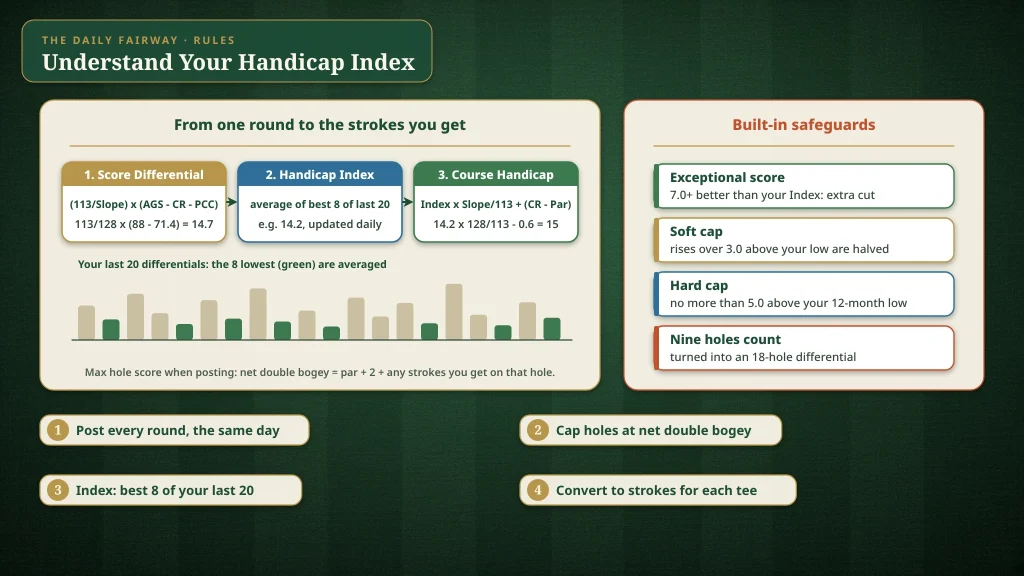
1. Each score becomes a Score Differential. After a round you post your Adjusted Gross Score, and the system compares it to the difficulty of the tees you played: Score Differential = (113 / Slope Rating) x (Adjusted Gross Score – Course Rating – PCC adjustment). The Course Rating is what a scratch golfer is expected to shoot. The Slope Rating measures how much harder the course plays for a bogey golfer, and 113 is standard. The PCC (Playing Conditions Calculation) adjusts for days when the weather or setup made everyone score higher or lower. Example: you shoot an adjusted 88 on tees rated 71.4 with a slope of 128. (113 / 128) x (88 – 71.4) = 14.7.
2. Your Index is the average of your best 8 of your last 20. The system takes your 20 most recent Score Differentials, averages the lowest 8 and updates it daily. That’s why it reflects your potential: bad rounds count less. Fewer than 20 scores? You can get an Index after 54 holes, for example three 18-hole rounds, and the system uses a smaller number of your best differentials until you reach 20.
3. Adjust bad holes before you post. Your maximum score on any hole is net double bogey: par, plus two, plus any handicap strokes you get on that hole. With a Course Handicap of 15, you get a stroke on the holes ranked 1 to 15 on the scorecard, so on a par 4 ranked 3, your maximum is 7. Until you have an Index, the maximum is par plus five. The system makes this adjustment when you post hole by hole, so that’s the easiest way to get it right.
4. Convert your Index to a Course Handicap at each course. Your Index is portable, but the strokes you get depend on the tees: Course Handicap = Handicap Index x (Slope Rating / 113) + (Course Rating – Par). With an Index of 14.2 on those same tees (slope 128, rating 71.4, par 72), you get 14.2 x 128 / 113 – 0.6 = 15.49, which rounds to 15 strokes. Harder tees give you more strokes, easier tees fewer. For competitions, the committee may apply an allowance to get your Playing Handicap: 95 percent is recommended for individual stroke play.
🛒 Many golfers practice this with SKLZ Gold Flex Swing Trainer — A weighted, flexible shaft that punishes a rushed transition and builds smooth tempo.
5. Know the safeguards. A round that is 7.0 or more strokes better than your Index counts as an exceptional score and triggers an extra reduction. To limit sudden rises, a soft cap halves any increase of more than 3.0 strokes above your lowest Index of the past 12 months, and a hard cap stops the increase at 5.0. The highest Index allowed is 54.0.
6. Post every acceptable round, and post it the same day. A round is acceptable when you play at least 9 rated holes by the Rules of Golf with at least one other person. Nine-hole rounds count too: since 2024, a 9-hole score is turned straight into an 18-hole Score Differential using your expected score for the other nine. Posting the same day lets the PCC include your round. Leaving out bad scores or keeping only good ones makes your handicap wrong and unfair to the field.
Check it yourself: Take a recent round, look up the Course Rating and Slope for your tees on the scorecard, adjust any hole over net double bogey and work out your Score Differential. Compare it with what your handicap app shows. Once the math makes sense, you’ll know whether a round should move your Index before it does.
Top picks for this tip
- 1
Alignment Sticks (2-pack)
Training Aids
The cheapest, most useful practice tool in golf: check aim, ball position and gate drills.
- 2
SKLZ Gold Flex Swing Trainer
Training Aids
A weighted, flexible shaft that punishes a rushed transition and builds smooth tempo.
- 3
Titleist Players 4 Stand Bag
Bags
A lightweight carry bag with a comfortable double strap for walking nine.
Watch it
World Handicap System (WHS) – Handicap Formula — Golf Association of Michigan
Sources & further reading
- Handicap Index Calculation · USGA
A Handicap Index is the average of the best 8 of the most recent 20 Score Differentials, with fewer used until 20 scores are posted. - World Handicap System FAQs · USGA
Score Differential, Course Handicap, exceptional score reduction, soft and hard caps, and 9-hole score posting explained. - Net Double Bogey · USGA
Maximum hole score for handicap purposes: par plus two plus any handicap strokes received on that hole.
FAQ
What is the "Understand Your Handicap Index" golf tip about?
A Handicap Index shows what you’re capable of shooting on a good day, not your average score. That one idea explains most of what confuses golfers about the World Handicap System, which the USGA and R&A run worldwide. Here’s how the numbers work, so you can post scores correctly and use your handicap fairly.
How do I put it into practice?
Each score becomes a Score Differential. After a round you post your Adjusted Gross Score, and the system compares it to the difficulty of the tees you played: Score Differential = (113 / Slope Rating) x (Adjusted Gross Score – Course Rating – PCC adjustment). The Course Rating is what a scratch golfer is expected to shoot. The Slope Rating measures how much harder the course plays for a bogey golfer, and 113 is standard. The PCC (Playing Conditions Calculation) adjusts for days when the weather or setup made everyone score higher or lower. Example: you shoot an adjusted 88 on tees rated 71.4 with a slope of 128. (113 / 128) x (88 – 71.4) = 14.7.
What’s the key takeaway?
Check it yourself: Take a recent round, look up the Course Rating and Slope for your tees on the scorecard, adjust any hole over net double bogey and work out your Score Differential. Compare it with what your handicap app shows. Once the math makes sense, you’ll know whether a round should move your Index before it does.
Ready to practice this? Our top pick for this tip is the Alignment Sticks (2-pack).
