 The Daily
Repair Spike Marks on Your Putting Line
Disclosure: Some links on this page are affiliate links. If you buy through them we may earn a commission at no extra cost to you. As an Amazon Associate I earn from qualifying purchases. Learn more.
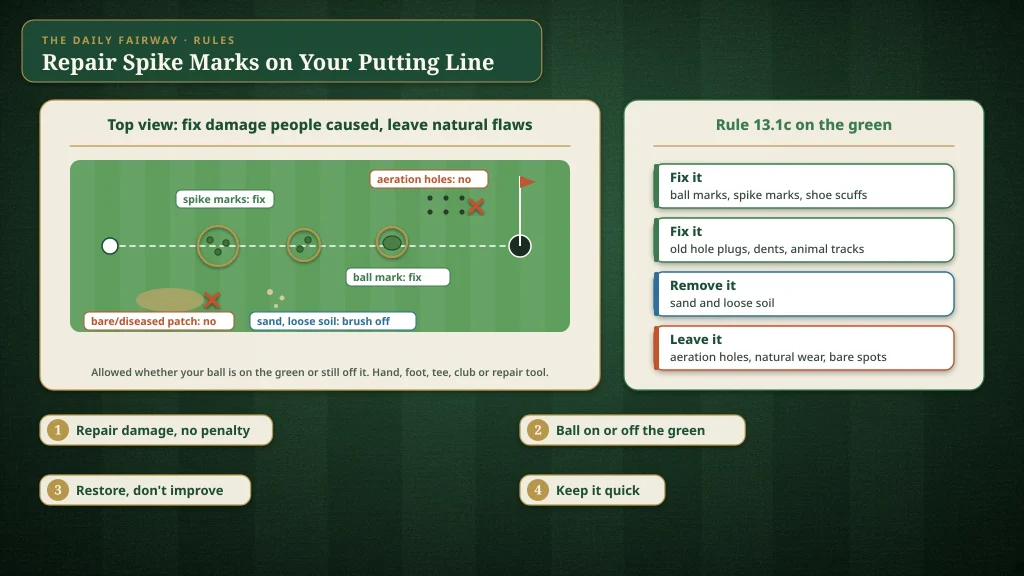
For decades golfers had to putt over spike marks and scuffs on their line and hope for a good bounce. That changed in 2019. Under Rule 13.1c, you may repair almost any damage on the putting green without penalty, and you can do it whether your ball is on the green or still off it. Damage covers more than ball marks: spike marks and other shoe damage, scrapes and dents from a club or the flagstick, old hole plugs, seams of cut turf, animal tracks and embedded objects like a stone or an acorn. You may also brush away sand and loose soil. Use your hand, your foot, a ball-mark repair tool, a tee or your club, and keep it quick so you don’t hold up play. The goal is to restore the green as nearly as possible to its original condition, not to build a better one. There are limits. You may not repair aeration holes or grooves from vertical mowing, damage from rain or other natural forces, natural surface imperfections such as bare or diseased patches, or the natural wear of the hole. If you’re not sure whether a mark counts, ask yourself whether a person or an outside influence caused it. If so, you can usually fix it. And always repair your own ball mark, plus one more.
🛒 Gear that helps with this: PuttOut Pressure Putt Trainer — A compact target that only keeps putts hit at the right speed. Great for the ladder and lag drills.
Why it works
Try it on your next range session, then take it to the course. Small, repeatable habits like this add up to lower scores.
🛒 Many golfers practice this with Odyssey White Hot Putter — A classic soft-feel insert putter that’s helped countless golfers with distance control.
Watch it
Rules of Golf Explained (2023): Putting Green — United States Golf Association (USGA)
Sources & further reading
- Rule 13: Putting Greens · The R&A
Rule 13.1c lets you repair damage on the putting green, including ball marks, shoe damage and old hole plugs, but not natural imperfections or aeration holes. - Repairing Damage on the Putting Green · USGA
Since 2019 you may repair almost any damage on the green, including spike marks, without penalty. - Rules Topics: Putting Green · USGA
USGA overview of what you can and can’t do on the putting green.
FAQ
What is the "Repair Spike Marks on Your Putting Line" golf tip?
For decades golfers had to putt over spike marks and scuffs on their line and hope for a good bounce. That changed in 2019. 1c, you may repair almost any damage on the putting green without penalty, and you can do it whether your ball is on the green or still off it. Damage covers more than ball marks: spike marks and other shoe damage, scrapes and dents from a club or the flagstick, old hole plugs, seams of cut turf, animal tracks and embedded objects like a stone or an acorn. You may also brush away sand and loose soil. Use your hand, your foot, a ball-mark repair tool, a tee or your club, and keep it quick so you don’t hold up play.
What else should I know about it?
The goal is to restore the green as nearly as possible to its original condition, not to build a better one. There are limits. You may not repair aeration holes or grooves from vertical mowing, damage from rain or other natural forces, natural surface imperfections such as bare or diseased patches, or the natural wear of the hole. If you’re not sure whether a mark counts, ask yourself whether a person or an outside influence caused it. If so, you can usually fix it. And always repair your own ball mark, plus one more.
Ready to practice this? Our top pick for this tip is the PuttOut Pressure Putt Trainer.
