 The Daily
Choose the Right Grip: Strong, Neutral or Weak
Disclosure: Some links on this page are affiliate links. If you buy through them we may earn a commission at no extra cost to you. As an Amazon Associate I earn from qualifying purchases. Learn more.
Your hands are the only part of you that touches the club, so how they sit on the grip has a big effect on where the clubface points at impact, and on whether your shots slice, hook or fly straight. "Strong" and "weak" have nothing to do with how tightly you hold on. They describe how far your hands are rotated on the handle. Here’s how to tell which grip you have, what each one does and how to pick the right one (written for a right-handed golfer).
🛒 Gear that helps with this: Alignment Sticks (2-pack) — The cheapest, most useful practice tool in golf: check aim, ball position and gate drills.
How to do it
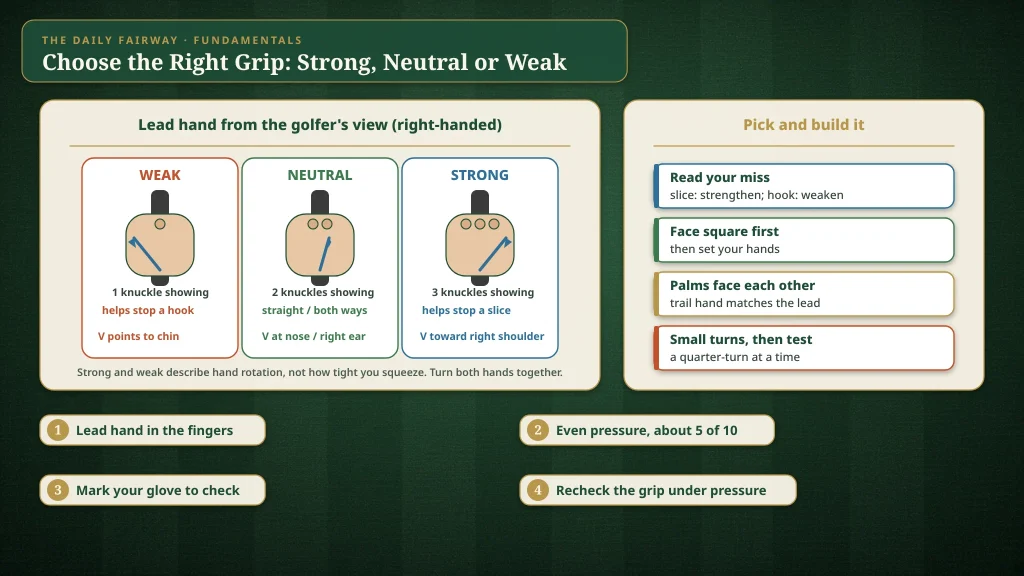
1. Learn the three grips. For a neutral grip, set your lead (left) hand on the club so you can see about two knuckles when you look down, with the V formed by your thumb and forefinger pointing roughly at your nose or right ear. For a strong grip, both hands rotate to the right, away from the target: three or more knuckles show on your left hand and the V’s point toward your right shoulder. For a weak grip, both hands rotate to the left: one knuckle or fewer shows and the V’s point toward your chin or left side.
2. Know what each grip does to the face. A GOLF.com instructor explains that a strong grip helps the clubface close through impact and promotes an in-to-out swing, so it’s a common cure for slices and weak fades. A weak grip keeps the face from closing as quickly, which helps players who fight a hook. A neutral grip suits golfers who already hit it fairly straight or like to work the ball both ways.
3. Diagnose your ball flight first. Look at your typical miss. If the ball curves hard to the right, your face is probably open at impact, and strengthening your grip a little is often the simplest fix. Golf Insider UK notes that a clubface only 4 to 6 degrees open or closed can cause a big slice or hook, so small grip changes matter. If the ball hooks left, try weakening it a touch.
4. Turn both hands together. Hank Haney sees a lot of grips where the left hand is strong and the right hand is neutral or weak, so the hands fight each other. His fix is to keep your palms facing each other and rotate both hands as a unit. Golf Insider UK gives the same order: decide on your grip, set the lead hand, then match the trail hand to it.
5. Keep the clubface aimed where it was. Tom Watson, writing in Golf Digest, says that when you change your grip, you shouldn’t turn the clubface along with your hands. Set the face square to your target first, then place your hands. Otherwise you’ve changed your aim instead of your grip.
6. Hold it in the fingers of your lead hand. Whatever style you choose, the handle should sit more in the fingers of your left hand than in the palm, with the heel pad on top of the grip. A palm grip makes it harder to hinge your wrists and square the face.
🛒 Many golfers practice this with FootJoy WeatherSof Golf Glove — A durable synthetic glove that holds its grip in heat and humidity without costing much.
7. Keep grip pressure the same. Haney adds that no matter where your V’s point, the pressure should be even in both hands and stay that way through the swing. On a 1-to-10 scale, about a 5 or 6 is plenty.
8. Make small changes, then test them. Move your hands a quarter-turn at a time, not a full knuckle at once. HowDidiDo Academy’s tip: draw two small marks on your glove over the knuckles you want to see, so you can check your grip at address on the course. A new grip will feel strange at first. Spend a full range session hitting balls with it before you judge it.
9. Get help if it keeps drifting. A GOLF.com explainer with a teaching pro makes the point that the best grip depends on how your body and swing move. If your grip keeps changing or your misses switch sides, a lesson or two with a coach is the fastest way to find the hold that works for you.
Practice it: Hit five balls each with a slightly weak, neutral and slightly strong grip using a 7-iron. Note the curve on each. Pick the grip that produces your straightest or most predictable shot, then hit 20 more balls with it, checking your knuckles and V’s before every swing.
On the course: Check your grip before every full shot, especially when you’re nervous. Hands tend to drift as rounds go on, and a quick look at your knuckles keeps a small problem from turning into a big miss.
Top picks for this tip
- 1
Alignment Sticks (2-pack)
Training Aids
The cheapest, most useful practice tool in golf: check aim, ball position and gate drills.
- 2
FootJoy WeatherSof Golf Glove
Apparel
A durable synthetic glove that holds its grip in heat and humidity without costing much.
- 3
Rukket Haack Practice Net
Training Aids
A backyard hitting net for full swings, so you can groove a move between range visits.
Watch it
Maintaining a NEUTRAL GOLF GRIP | HowDidiDo Academy — HowDidiDo
Sources & further reading
- What’s the difference between a strong, weak and neutral golf grip? · GOLF.com
Strong grip V’s point right and help cure slices; neutral V’s point at the nose; weak V’s point left and help players who hook. - Let your hands work together · Golf Digest
Hank Haney: palms face each other, rotate both hands together to strengthen or weaken, and keep grip pressure even in both hands. - The easy way to shape shots · Golf Digest
Tom Watson: two knuckles is neutral, three is strong, one is weak; don’t turn the clubface as you turn your hands. - Strong, Weak & Neutral Golf Grips – Which is Best for You? · Golf Insider UK
A face only 4-6 degrees open or closed causes a big slice or hook; set the lead hand, then mirror it with the trail hand. - Should you use a weak grip or a strong grip? Top teacher explains · GOLF.com
The right grip depends on how your body and swing move; a coach can help you find it, and a new grip gets comfortable with practice.
FAQ
What is the "Choose the Right Grip: Strong, Neutral or Weak" golf tip about?
Your hands are the only part of you that touches the club, so how they sit on the grip has a big effect on where the clubface points at impact, and on whether your shots slice, hook or fly straight. "Strong" and "weak" have nothing to do with how tightly you hold on. They describe how far your hands are rotated on the handle. Here’s how to tell which grip you have, what each one does and how to pick the right one (written for a right-handed golfer).
How do I put it into practice?
Learn the three grips. For a neutral grip, set your lead (left) hand on the club so you can see about two knuckles when you look down, with the V formed by your thumb and forefinger pointing roughly at your nose or right ear. For a strong grip, both hands rotate to the right, away from the target: three or more knuckles show on your left hand and the V’s point toward your right shoulder. For a weak grip, both hands rotate to the left: one knuckle or fewer shows and the V’s point toward your chin or left side.
What’s the key takeaway?
On the course: Check your grip before every full shot, especially when you’re nervous. Hands tend to drift as rounds go on, and a quick look at your knuckles keeps a small problem from turning into a big miss.
Ready to practice this? Our top pick for this tip is the Alignment Sticks (2-pack).
