 The Daily
Equipment
 Quick · 1 min Equipment
Build a Smarter 14-Club Bag
The Rules of Golf let you carry up to 14 clubs, but which 14 matters more than most golfers think. Many bags have two clubs that fly the same distance at the top, a gap in the wedges and a long iron that never gets hit. Golf Digest compares your bag to the 14 friends you take with you for a round: choose them carefully. Here's how to build a set that covers every yardage you actually face (written for any golfer, right- or left-handed).
 Quick · 1 min Equipment
Check Your Lie Angle With the Marker Line Test
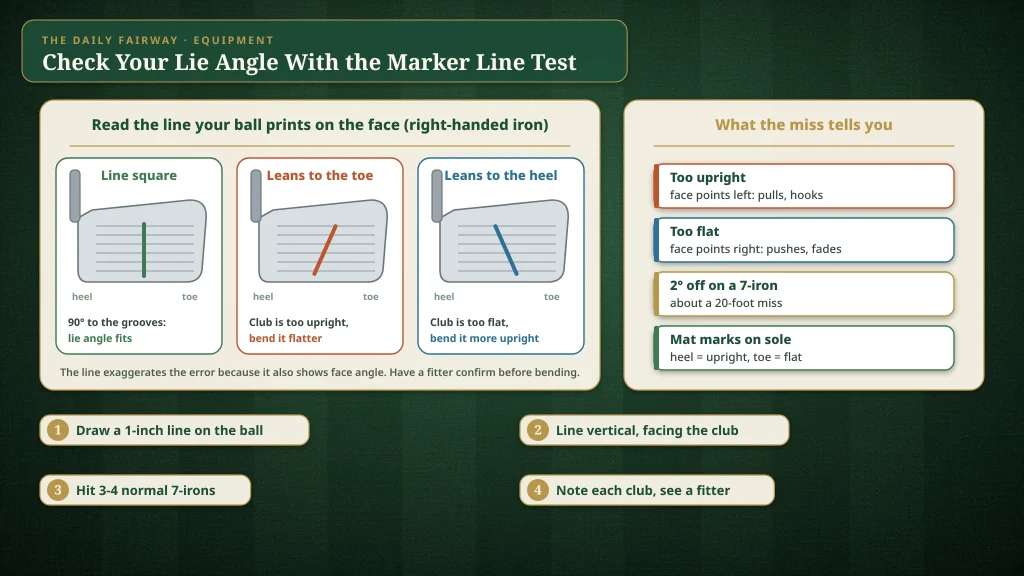
If you hit a pure-feeling iron that still starts left or right of where you aimed, the problem may be your clubs, not your swing. Lie angle is the angle between the shaft and the ground when the sole sits flat. GOLF.com's Ryan Barath explains that irons that are too flat for you make the face point open at impact, so shots miss right (for a right-handed golfer), while irons that are too upright point the face left and cause pulls. Golf Digest cites Titleist research that a 7-iron just 2 degrees off can send the ball about 20 feet wide of the target. You can check yours in 15 minutes with a marker and a few range balls.
 Quick · 1 min Equipment
Replace Worn Grips at Least Once a Year
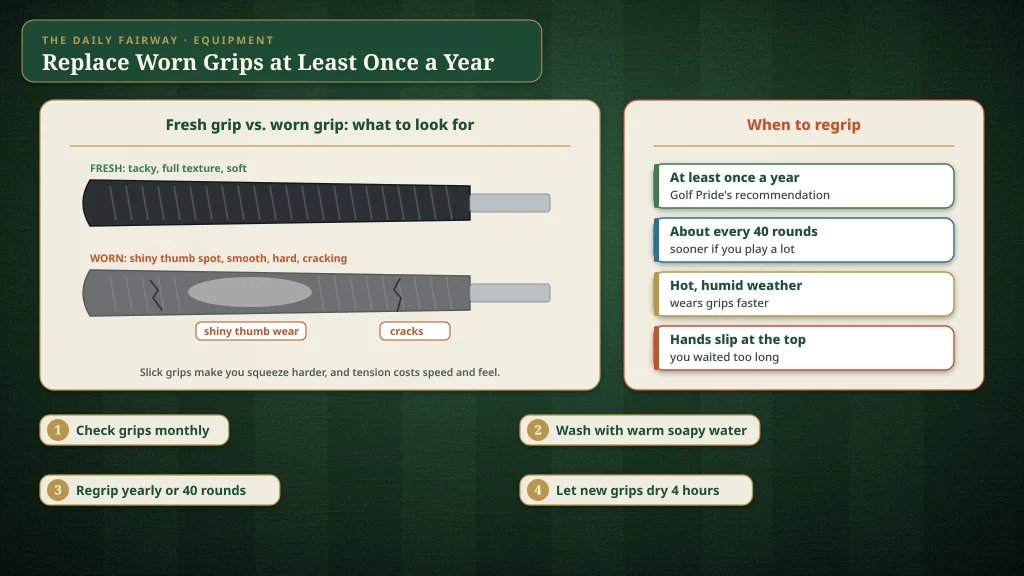
Your grips are the only part of the club you touch on every swing, and they wear out quietly. Sweat, sunscreen, dirt and heat break down the rubber until it turns shiny, slick or hard. When that happens, you squeeze harder to keep the club from twisting, and extra grip pressure tightens your forearms and costs you clubhead speed and feel. Golf Pride recommends regripping at least once a year, and sooner if you play a lot, practice often or play in hot, humid weather; the common rule of thumb is about every 40 rounds. Check your grips once a month for three warning signs: a shiny or slick surface, smooth worn spots where your thumbs sit, and rubber that feels hard or has started to crack. If your hands slide at the top of the swing, you've waited too long. In between, wash your grips with warm, soapy water and a soft brush, rinse and towel them dry; Golfweek notes that a good scrub can bring back some of their tack. A shop install usually costs only a few dollars per club plus the grips, and if you do it yourself, Golf Pride says to let the new grips dry for at least four hours before you play.
 Quick · 1 min Equipment
Clean Your Grooves Before Every Shot
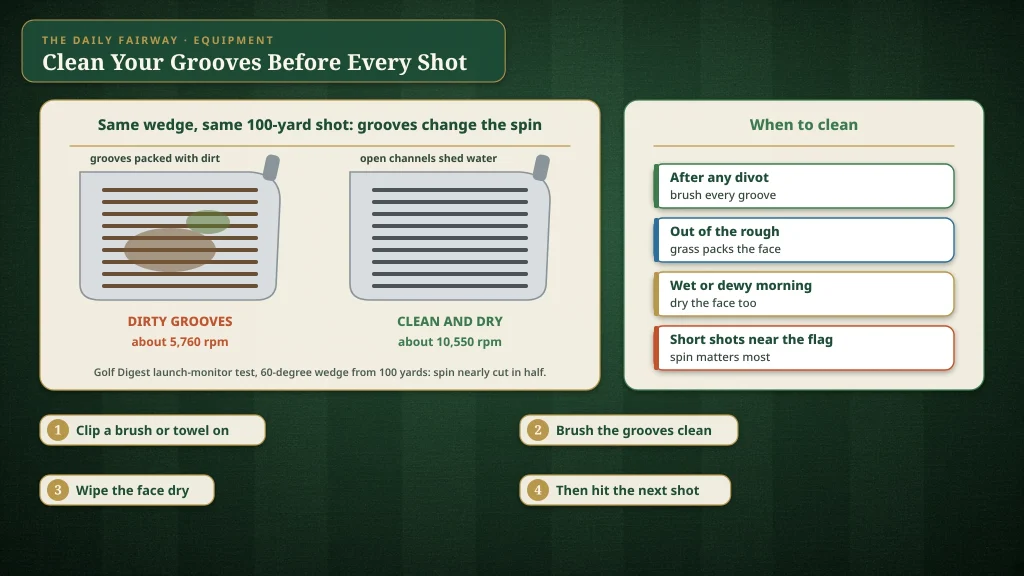
The grooves on your irons and wedges aren't decoration. Their job is to channel grass, dirt and water away from the spot where the clubface meets the ball, so the face can grip the cover and create spin. Pack them with dirt and they can't do that job. Golf Digest tested it with a 60-degree wedge and a launch monitor from 100 yards: after taking a divot and not cleaning the face, spin dropped from just over 10,500 rpm to about 5,760, nearly half. That lost spin matters most on short shots, where you need the ball to check instead of releasing past the hole. The fix takes two seconds. Clip a groove brush or a towel to your bag, and after every shot that takes a divot or comes out of the rough, scrub the grooves clean, then wipe the face dry before your next swing. Top teacher Trillium Rose tells GOLF.com that clean, dry grooves are a key ingredient for spin, and on dewy or wet mornings, drying the face counts as much as cleaning it.
 Quick · 1 min Equipment
Gap Your Wedges the Right Way
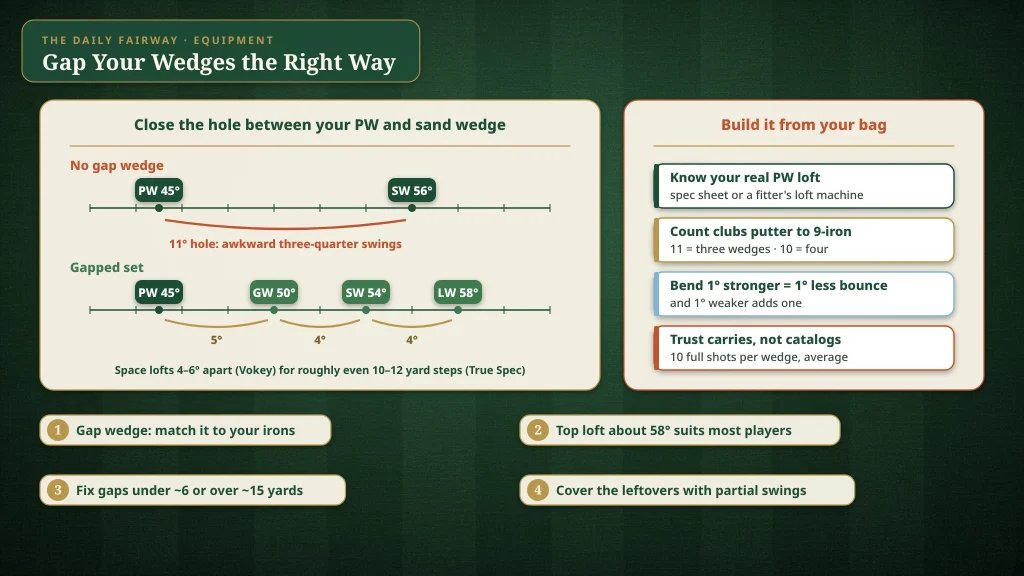
Most golfers buy irons as a matched set and pick up wedges one at a time, and that's how a big hole ends up right in the scoring zone. Manufacturers have been strengthening iron lofts for decades, so the pitching wedge in many modern sets is around 45 degrees or less, while a typical sand wedge is still 54 to 56 degrees. If nothing sits between them, the full-swing shots you face all the time from roughly 80 to 120 yards turn into awkward three-quarter swings. Good wedge gapping fixes that by giving you a club for a full, confident swing at more of the yardages you actually face.
 In-Depth · 10 min Equipment
How to Choose a Golf Ball
The right ball is chosen from the green back to the tee.
 Medium · 3 min Equipment
Get Fitted for the Right Equipment
Clubs with the wrong shaft flex, lie angle or length can cost you consistency. A basic fitting checks your swing speed, launch and dispersion.
 In-Depth · 10 min Equipment
Club Fitting Guide
Properly fitted clubs make your best swing produce better results.
 Medium · 3 min Equipment
Hybrids Are Your Friend
Most golfers over a 10 handicap hit hybrids higher and more consistently than 3-, 4- and even 5-irons.
 In-Depth · 10 min Equipment
Understanding Bounce and Grind
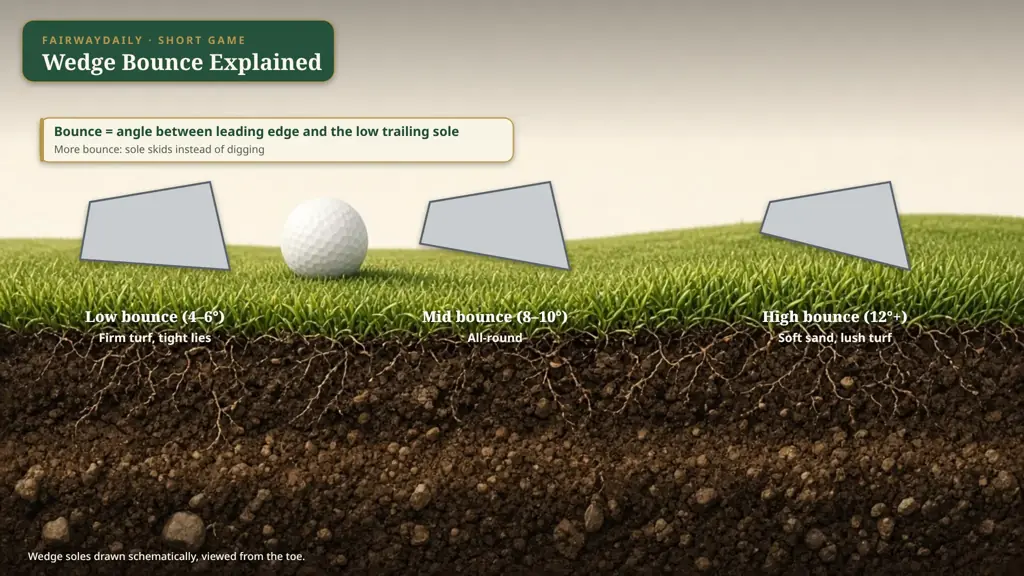
Wedge bounce is the angle between the leading edge and the lowest point of the sole. It prevents the club from digging.