 The Daily
Gap Your Wedges the Right Way
Disclosure: Some links on this page are affiliate links. If you buy through them we may earn a commission at no extra cost to you. As an Amazon Associate I earn from qualifying purchases. Learn more.
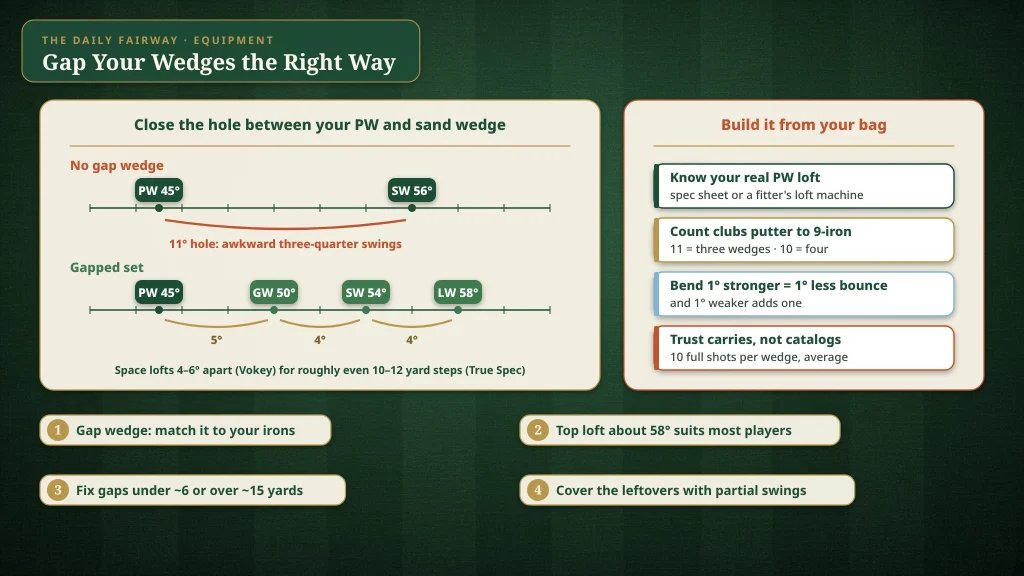
Most golfers buy irons as a matched set and pick up wedges one at a time, and that’s how a big hole ends up right in the scoring zone. Manufacturers have been strengthening iron lofts for decades, so the pitching wedge in many modern sets is around 45 degrees or less, while a typical sand wedge is still 54 to 56 degrees. If nothing sits between them, the full-swing shots you face all the time from roughly 80 to 120 yards turn into awkward three-quarter swings. Good wedge gapping fixes that by giving you a club for a full, confident swing at more of the yardages you actually face.
🛒 Gear that helps with this: Cleveland RTX ZipCore Wedge — A spin-focused wedge offered in multiple lofts and grinds, so you can match bounce to your turf.
How to do it
1. Find your real pitching wedge loft. Don’t assume it matches an older set. Look up the loft on your iron set’s spec sheet, or have a club shop or fitter measure it. Every other wedge loft is built from this one, and Golf Digest’s guideline is that if your pitching wedge is 45 degrees or less, you’ll want three more wedges spaced no more than 4 to 5 degrees apart.
2. Space your lofts 4 to 6 degrees apart. Vokey recommends 4 to 6 degrees of separation between wedges; a 44-degree pitching wedge, for example, pairs with a 48- or 50-degree gap wedge. A common progression for a 45-degree pitching wedge is 50, 54 and 58. True Spec’s Matt Morin aims for the traditional 10 to 12 yards between each wedge, starting with the pitching wedge, and lets those gaps decide the lofts.
3. Count your bag before you buy. The Rules let you carry 14 clubs, so a fourth wedge has to replace something. Golf Digest suggests counting every club from your putter up to and including your 9-iron: if that’s 11 clubs, you have room for three wedges; if it’s 10, you have room for four. The usual candidate to drop is a long iron, hybrid or fairway wood you rarely hit well. Morin’s reasoning is that every golfer has more scoring chances from 140 yards and in than from 200 to 230 yards, so extra options at the bottom of the bag usually pay off.
4. Treat the gap wedge like an iron, and the higher lofts like specialists. Your gap wedge is mostly a full-swing club, so Golf Digest recommends matching it to your short irons and pitching wedge. Your sand and lob wedges do more of their work around the green, which is where bounce and grind matter most. Golf Digest also argues that a highest loft of about 58 degrees gives most players the best mix of versatility and solid contact; go higher only if you really use it.
🛒 Many golfers practice this with Frogger Amphibian Golf Towel — A wet/dry towel that clips to your bag. Clean grooves before every wedge for more spin.
5. Fine-tune with a bend, but watch the bounce. Wedges can easily be bent a degree or two stronger or weaker to tidy up a gap. The catch: every degree stronger takes away about a degree of bounce, and every degree weaker adds one. Bend a 56-degree wedge to 55 and the sole digs a little more, so keep that in mind if you play soft turf or fluffy bunkers.
6. Trust carry numbers, not catalog lofts. Strike quality, shaft and swing speed all change how far each wedge goes. Club Champion’s Nick Sherburne puts it bluntly: feel isn’t always real, and you need data. Hit ten full shots with each wedge on a launch monitor or to a measured target, ignore the longest and shortest, and average the rest. You’re looking for roughly even steps. If two wedges carry within a few yards of each other, one of them is wasting a spot in your bag; if one gap is 20 yards or more, bend, swap or add a club to fill it.
7. Fill the leftovers with partial swings. No set of lofts covers every number. Once your full-swing gaps are even, use a simple partial-swing system, such as shorter backswings or gripping down, to cover the yardages in between, and write every number on a card you keep in your bag.
Practice plan: Write down the loft of every club from your 9-iron down, then measure your full-swing carry with each one on a launch monitor or to measured flags, ten balls per club. Mark any gap smaller than about 6 yards or bigger than about 15 yards. Fix the biggest problem first, whether that’s a loft bend, a different wedge or a fourth wedge in place of a club you rarely hit, then re-measure. Finish by adding one partial-swing number for each wedge to your yardage card and test them during your next two rounds.
Top picks for this tip
- 1
Cleveland RTX ZipCore Wedge
Clubs
A spin-focused wedge offered in multiple lofts and grinds, so you can match bounce to your turf.
- 2
Frogger Amphibian Golf Towel
Accessories
A wet/dry towel that clips to your bag. Clean grooves before every wedge for more spin.
- 3
Titleist Pro V1 Golf Balls
Balls
A tour-level urethane ball that grabs on chips and pitches. Worth it once your contact is consistent.
Watch it
Inside a Vokey SM11 Wedge Fitting — Titleist Canada
Sources & further reading
- Pitching, Gap, Lob & Sand Wedge Lofts: Everything you need to know · Golf Digest
Count clubs through the 9-iron to see if there’s room for three or four wedges, space them 4-5 degrees from a 45-degree or stronger PW, match the gap wedge to the irons, and every degree of bend changes bounce by a degree. - Clubfitting tip: What you should know about adjusting your wedge gapping · Golf Digest
Club Champion’s Nick Sherburne: build wedge lofts from the shortest iron with 4-6 degrees of separation, carry three or four wedges, and use data because feel isn’t always real. - How many wedges should you carry? Ask yourself these questions · GOLF.com
True Spec’s Matt Morin: more scoring chances come from 140 yards and in, aim for the traditional 10-12 yard gap between wedges, and let your short-game style shape the set. - Gap Wedges: Your in-between scoring club · Vokey (Titleist)
Vokey recommends 4 to 6 degrees of loft separation between wedges; for example, a 44-degree pitching wedge pairs with a 48- or 50-degree gap wedge. - Rule 4: The Player’s Equipment · The R&A
Rule 4.1b: no more than 14 clubs; two penalty strokes per hole in breach (maximum four) in stroke play, a hole deducted per hole (maximum two) in match play; take excess clubs out of play before the next stroke. Rule 4.1a(3) bars applying substances to the clubhead during a round.
FAQ
What is the "Gap Your Wedges the Right Way" golf tip about?
Most golfers buy irons as a matched set and pick up wedges one at a time, and that’s how a big hole ends up right in the scoring zone. Manufacturers have been strengthening iron lofts for decades, so the pitching wedge in many modern sets is around 45 degrees or less, while a typical sand wedge is still 54 to 56 degrees. If nothing sits between them, the full-swing shots you face all the time from roughly 80 to 120 yards turn into awkward three-quarter swings. Good wedge gapping fixes that by giving you a club for a full, confident swing at more of the yardages you actually face.
How do I put it into practice?
Find your real pitching wedge loft. Don’t assume it matches an older set. Look up the loft on your iron set’s spec sheet, or have a club shop or fitter measure it. Every other wedge loft is built from this one, and Golf Digest’s guideline is that if your pitching wedge is 45 degrees or less, you’ll want three more wedges spaced no more than 4 to 5 degrees apart.
What’s the key takeaway?
Practice plan: Write down the loft of every club from your 9-iron down, then measure your full-swing carry with each one on a launch monitor or to measured flags, ten balls per club. Mark any gap smaller than about 6 yards or bigger than about 15 yards. Fix the biggest problem first, whether that’s a loft bend, a different wedge or a fourth wedge in place of a club you rarely hit, then re-measure. Finish by adding one partial-swing number for each wedge to your yardage card and test them during your next two rounds.
Ready to practice this? Our top pick for this tip is the Cleveland RTX ZipCore Wedge.
