 The Daily
Rules
 Quick · 1 min Rules
Mark Your Ball Before You Lift It
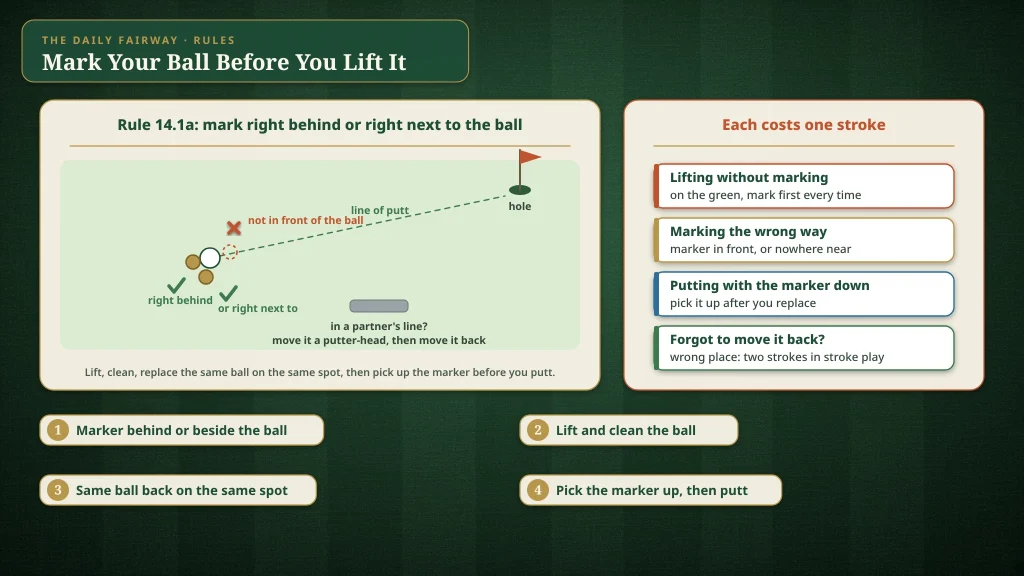
Picking your ball up on the green is so routine that it's easy to get careless, but the Rules are specific. Under Rule 14.1a, before you lift a ball that has to go back on the same spot, you must mark that spot. You have two choices: set a ball-marker (a coin or a proper marker) right behind or right next to the ball, or hold a club on the ground right behind or right next to it. Marking in front of the ball isn't one of the options. Then lift it, clean it if you like, and set the same ball back on the exact spot. Before you putt, pick the marker up. Lifting without marking, marking the wrong way, or making a stroke with the marker still on the ground each costs one penalty stroke. If your marker sits in a partner's line, move it one or more putter-head lengths to the side, using a fixed point such as a tree to measure. Then do the same thing in reverse before you replace your ball. Forget to move it back and you've played from the wrong place, which is two strokes in stroke play. A simple habit helps: marker down, ball up, ball down, marker up, every time.
 Quick · 1 min Rules
Know Your Three Unplayable Ball Options
Your ball is wedged under a bush, against a tree root or buried in a bunker face. You don't have to hack at it. The Rules let you declare your ball unplayable almost anywhere on the course, and you're the only one who gets to make that call. The one exception: if your ball is in a penalty area (red or yellow stakes), you have to use the penalty area Rule instead. Every unplayable option costs one penalty stroke, so the smart move is choosing the one that leaves the easiest next shot.
 Quick · 1 min Rules
Drop From Knee Height
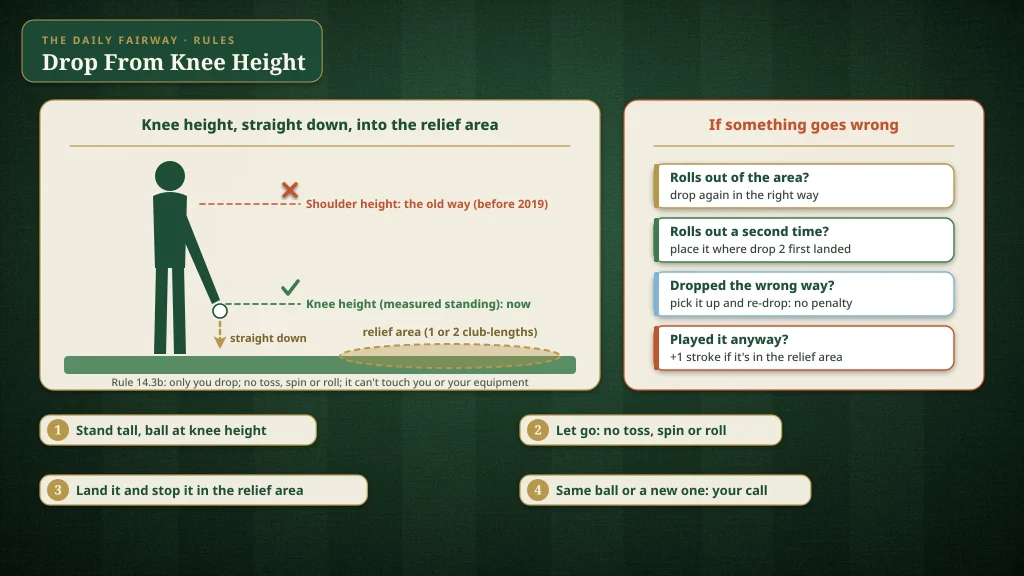
Since 2019 the Rules of Golf have required a drop from knee height, not shoulder height, and it's still one of the most common mistakes on the course. Stand up straight, hold the ball at the height of your knee and simply let go. The ball has to fall straight down: no tossing, spinning or rolling it, and it can't touch your body or your equipment before it hits the ground. You don't have to be standing when you drop, but the height is measured from your knee when you are. Only you may drop your ball, not your caddie, and it must land in your relief area and come to rest there. If a correctly dropped ball rolls out, drop again; if it rolls out a second time, place a ball on the spot where the second drop first hit the ground. You can use the same ball or a different one. Dropped it from your shoulder out of habit? Pick it up and drop again with no penalty. Play it from there instead and, if it's in the relief area, you add one penalty stroke.
 Quick · 1 min Rules
Count Your Clubs Before Every Round
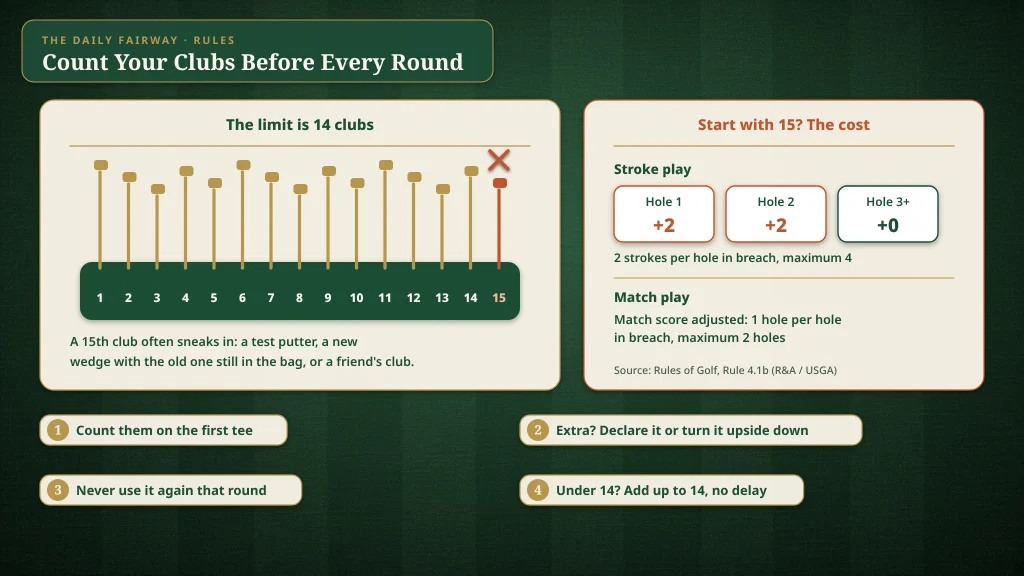
Before you walk to the first tee, count the clubs in your bag. The Rules let you carry 14 at most, and extras sneak in easily: a second putter you were testing, a new wedge you haven't taken the old one out for, or a friend's club dropped in your bag. Start with 15 and it costs two penalty strokes for each hole you play in breach, up to four in stroke play; in match play the score is adjusted by a hole per hole, up to two. The moment you notice, take the extra out of play before your next stroke by telling your marker or playing partners or turning it upside down in your bag, and don't use it again. Fewer than 14 is fine, and you can add clubs up to 14 as long as you don't delay play.
 Quick · 1 min Rules
Play a Provisional Ball
If your tee shot might be lost or out of bounds, announce "provisional" and hit another before walking forward. It saves a walk back if the first ball isn't found within three minutes.
 In-Depth · 10 min Rules
Golf Rules Every Player Should Know
Knowing the rules saves strokes and time.
 Quick · 1 min Rules
Don’t Ground the Club in Hazards
In a bunker you can't touch the sand with your club before the stroke. In a penalty area, under the current Rules you can.