 The Daily
Rules
 Quick · 1 min Rules
Know When Your Ball Is Really Out of Bounds
Before you reload, walk up and look. Under Rule 18.2, a ball is out of bounds only when all of it is outside the boundary edge of the course. If any part of the ball touches or sits above the course side of that edge, it's in bounds and you play it as it lies. When white stakes or a fence mark the boundary, the edge is the line between the course-side points of the stakes or posts at ground level, so picture a string running along their inside edges at the bottom. The stakes themselves are out of bounds: they're boundary objects, so you can't move them and you don't get free relief from them. A painted line works the same way, and the line itself is out of bounds. You're allowed to stand out of bounds to play a ball that's still in. If the ball is fully out, the penalty is stroke and distance: add one stroke and play again from where you last hit. Some courses adopt Model Local Rule E-5, which lets you drop near where the ball went out or in the nearest fairway for two penalty strokes instead, so check the scorecard. And if you think a shot might be out, hit a provisional before you walk forward.
 Quick · 1 min Rules
No Penalty for Accidentally Moving Your Ball on the Green
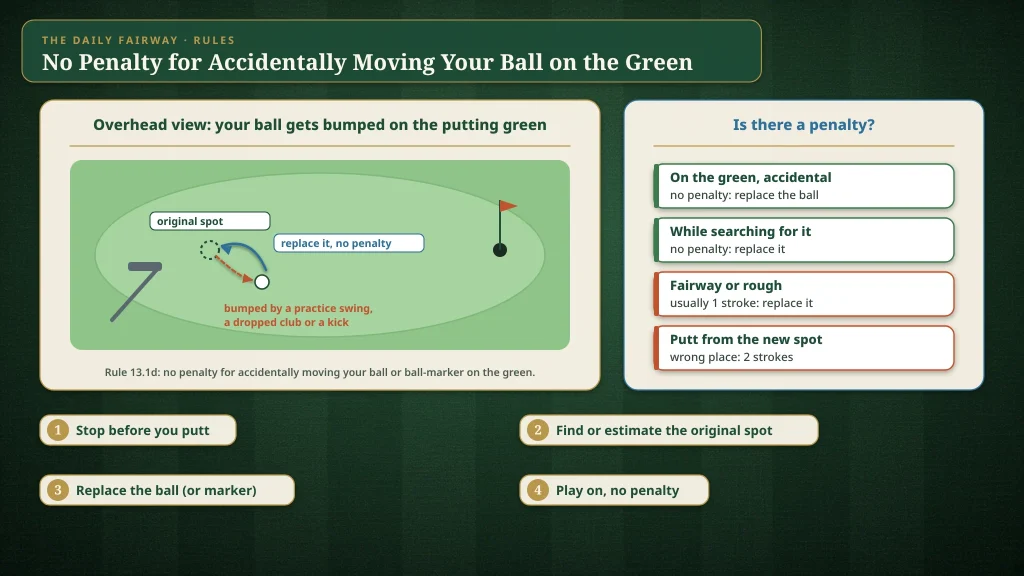
It happens to everyone: you bump your ball with the putter as you set up, drop your marker on it, or a playing partner kicks it walking past. On the putting green, none of that costs you a stroke. Under Rule 13.1d, there's no penalty if you, your opponent or another player in stroke play accidentally moves your ball or ball-marker on the green. The USGA's examples include hitting the ball with a practice swing, moving it while you mark it, kicking it, dropping a club on it and bumping it with your putter at address. The fix is the same every time: put the ball back on its original spot, and if you don't know exactly where that was, estimate it. Don't putt it from where it ended up, because playing from the wrong place is a two-stroke penalty in stroke play (loss of hole in match play). Remember this only applies on the green. In the fairway or rough, accidentally moving your ball is still usually a one-stroke penalty, except in cases like moving it while searching for it. And if wind or gravity moves your ball on the green after you've lifted and replaced it, put it back; if it moves before you've marked it, play it from its new spot.
 Quick · 1 min Rules
Take Free Relief From Temporary Water
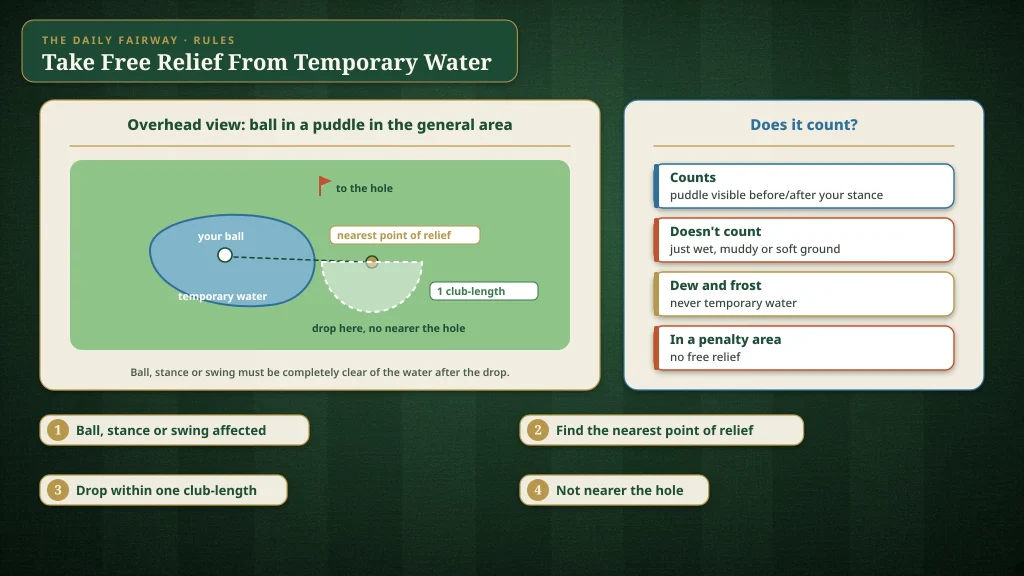
After heavy rain or a long night of sprinklers, puddles show up in fairways and rough. The Rules of Golf call that temporary water, and under Rule 16.1 you get free relief when your ball lies in it or it interferes with your stance or the area of your intended swing (on the putting green it also counts when it's on your line). The water has to be visible before or after you take your stance without pressing down hard with your feet. As Golf Digest's rules review points out, ground that's merely wet, muddy or soft doesn't qualify, and neither does dew or frost. To take relief in the general area, find the nearest point of complete relief no nearer the hole, then drop a ball within one club-length of that spot, no nearer the hole, so that the water no longer touches your ball, stance or swing. Overflow outside a penalty area's red or yellow lines counts too, but there's no free relief from water inside a penalty area.
 Quick · 1 min Rules
Identify Your Ball Before You Hit It
Playing someone else's ball is one of the easiest penalties to avoid. Under Rule 6.3c, if you make a stroke at a wrong ball you get two penalty strokes in stroke play, or lose the hole in match play. In stroke play, the strokes you made with the wrong ball don't count, but you still have to go back and play your own ball, either as it lies or under the Rules. If your ball is lost, that means stroke and distance on top of the two strokes. Fix the mistake before you tee off on the next hole (or, on the last hole, before you return your scorecard), or you're disqualified. A wrong ball can be a playing partner's ball, a stray ball in the rough, or even your own ball after the three-minute search time has run out. The fix takes five seconds. Before the round, put your own mark on every ball with a marker, like two dots or your initials, and tell your group what brand, number and mark you're playing. When you reach a ball in the rough, look for your mark before you hit. If you can't see it, Rule 7.3 lets you lift the ball to identify it: mark its spot first, don't clean it more than you need to see the mark, and put it back on the same spot. There's one exception: there's no penalty for hitting a wrong ball that's moving in water in a penalty area or temporary water, but you still have to correct it.
 Quick · 1 min Rules
Repair Spike Marks on Your Putting Line
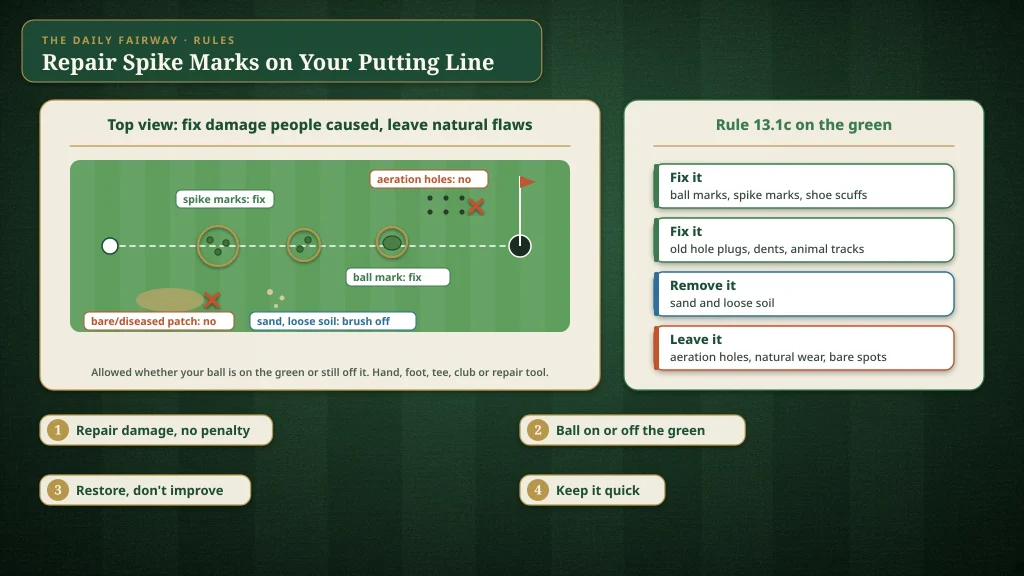
For decades golfers had to putt over spike marks and scuffs on their line and hope for a good bounce. That changed in 2019. Under Rule 13.1c, you may repair almost any damage on the putting green without penalty, and you can do it whether your ball is on the green or still off it. Damage covers more than ball marks: spike marks and other shoe damage, scrapes and dents from a club or the flagstick, old hole plugs, seams of cut turf, animal tracks and embedded objects like a stone or an acorn. You may also brush away sand and loose soil. Use your hand, your foot, a ball-mark repair tool, a tee or your club, and keep it quick so you don't hold up play. The goal is to restore the green as nearly as possible to its original condition, not to build a better one. There are limits. You may not repair aeration holes or grooves from vertical mowing, damage from rain or other natural forces, natural surface imperfections such as bare or diseased patches, or the natural wear of the hole. If you're not sure whether a mark counts, ask yourself whether a person or an outside influence caused it. If so, you can usually fix it. And always repair your own ball mark, plus one more.
 Quick · 1 min Rules
Clear Fallen Leaves Without Moving Your Ball
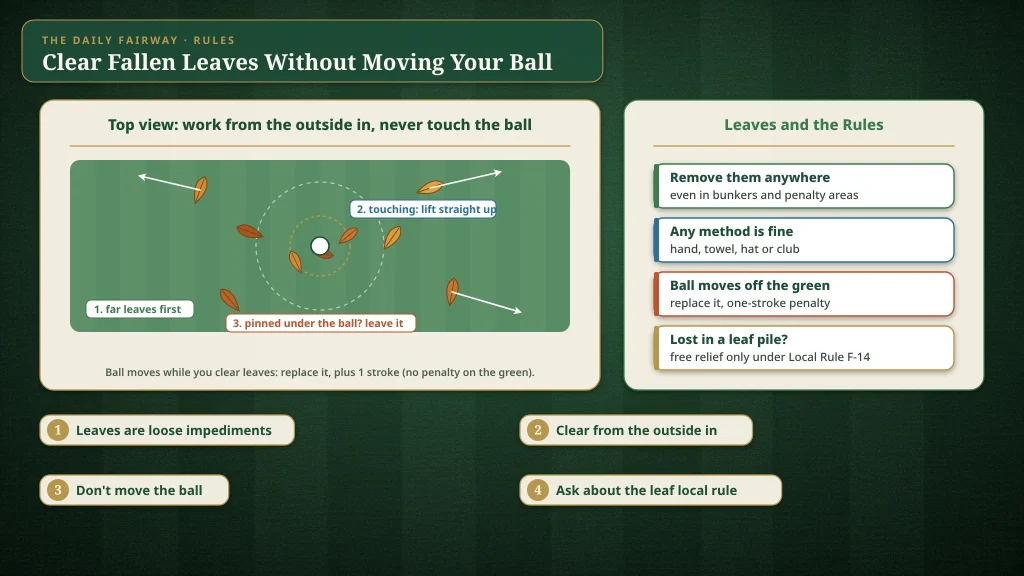
Fall golf means leaves everywhere: in the fairway, piled under trees and scattered around your ball. The good news is that the Rules of Golf treat leaves as loose impediments, the same as stones, twigs, pine cones and loose grass, and since 2019 you may remove them anywhere on the course without penalty, including in a bunker or a penalty area. You can use any method: your hand, a towel, your hat or a club. The catch is the ball itself. If removing a leaf causes your ball to move, you must put the ball back on its original spot, and anywhere except the putting green or the teeing area that costs you one penalty stroke. On the green there is no penalty; just replace the ball and putt. So work from the outside in: pick off the leaves farthest from the ball first, then lift the ones touching it gently, straight up and away. If a leaf is pinned under the ball, leave it alone; it isn't worth a stroke. And if your ball disappears into a big pile, don't assume you get free relief. That only applies if your course or committee has put Model Local Rule F-14 in effect, which lets areas with temporary piles of leaves be treated as ground under repair, even if you can't find your ball. Ask in the pro shop before your round.
 Quick · 1 min Rules
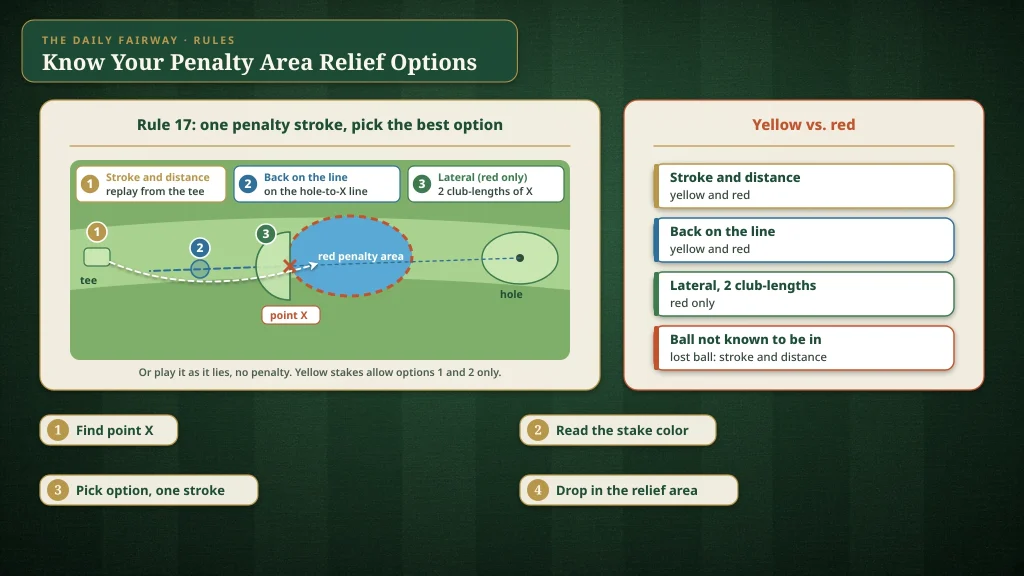
Know Your Penalty Area Relief Options
Water, ravines, desert and thick native areas marked by red or yellow stakes or lines are all penalty areas under the Rules of Golf. Hitting into one doesn't have to mean a big number. Plenty of strokes are lost not to the water itself but to the wrong drop: going back too far, dropping on the wrong side, or using a red-stake option on a yellow-stake hazard. Here's how to read the stakes and pick the option that costs you the least.
 Quick · 1 min Rules
Take Free Relief From a Cart Path
When your ball comes to rest on a paved or gravel cart path, or the path gets in the way of your stance or swing, you don't have to play it from there. Under Rule 16 of the Rules of Golf, a cart path is an immovable obstruction, and in the general area you get free relief. First, find the nearest point of complete relief. That's the spot nearest to where your ball lies, but not nearer the hole, where the path no longer touches your ball, your stance or your swing for the shot you would have played. Use the club you'd actually hit, and remember it's the nearest point, not the nicer side of the path. The USGA notes it must be on the course, in the general area, and not in a bunker, penalty area or on the putting green. Mark that spot with a tee, then drop a ball within one club-length of it, no nearer the hole, and it has to come to rest in the relief area. There's no penalty. Relief is optional, so if the nearest point leaves you in thick rough or behind a tree, you're allowed to play the ball off the path instead.
 Quick · 1 min Rules
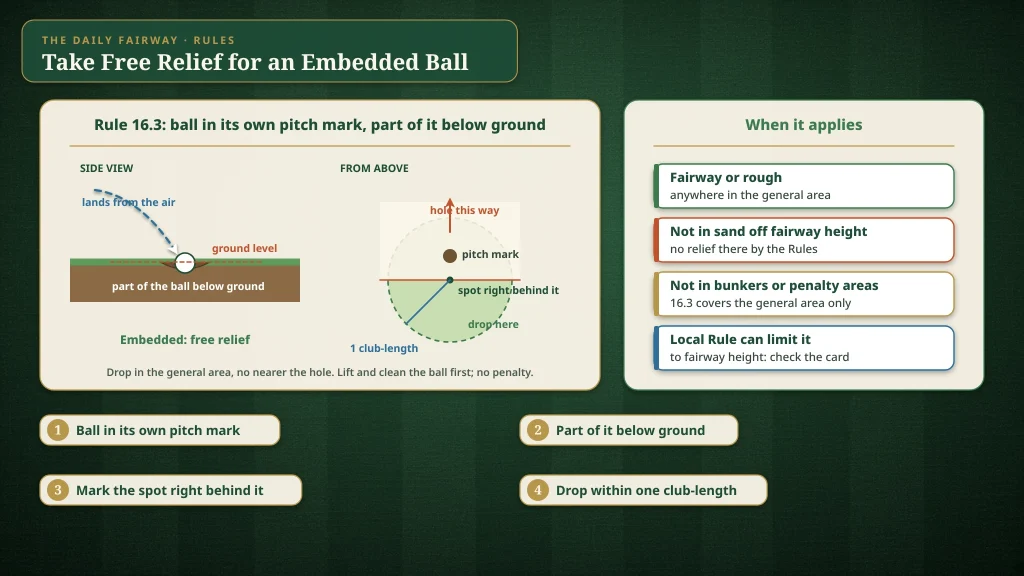
Take Free Relief for an Embedded Ball
After a soft, rainy week, your approach shot can plug in its own pitch mark and sit half buried in the turf. Don't try to dig it out. Under Rule 16.3 of the Rules of Golf, a ball embedded anywhere in the general area (fairway or rough) gets free relief. It counts as embedded when it's in its own pitch mark from the stroke you just played and part of the ball is below the level of the ground. A ball that's just nestled down in thick grass doesn't count. To take relief, lift the ball (you can clean it), find the spot right behind where it was embedded and drop within one club-length of that spot, no nearer the hole and still in the general area. There's no penalty. Two exceptions: no relief for a ball embedded in sand in an area not cut to fairway height, and none in a bunker or penalty area. Also, a course can limit relief to areas cut to fairway height or less by Local Rule, so check the scorecard. On the putting green, you don't need this rule: mark, lift and clean the ball, repair the pitch mark and replace it.
 Quick · 1 min Rules
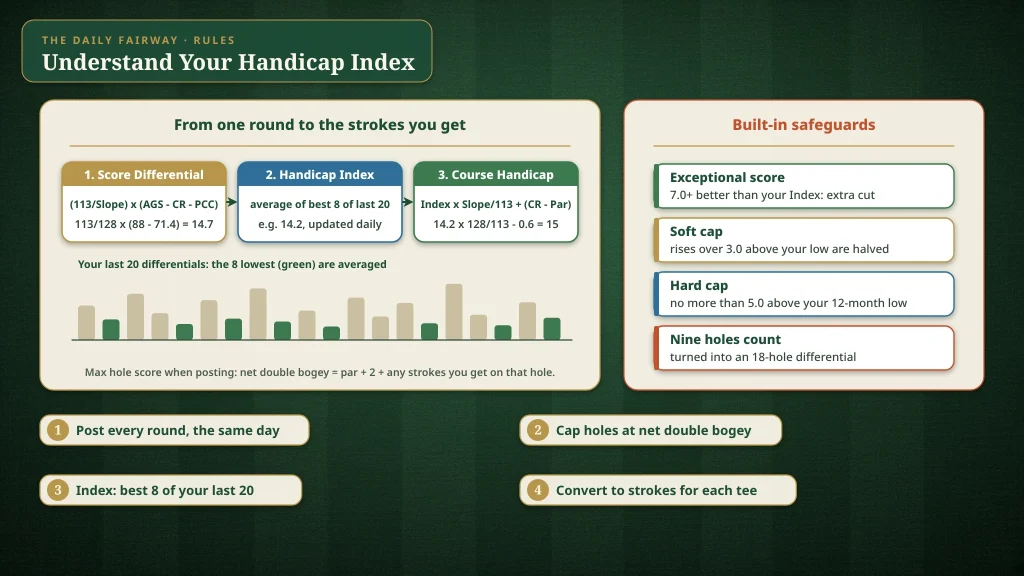
Understand Your Handicap Index
A Handicap Index shows what you're capable of shooting on a good day, not your average score. That one idea explains most of what confuses golfers about the World Handicap System, which the USGA and R&A run worldwide. Here's how the numbers work, so you can post scores correctly and use your handicap fairly.