 The Daily
Short Game
 Quick · 1 min Short Game
Pick a Landing Spot for Every Chip
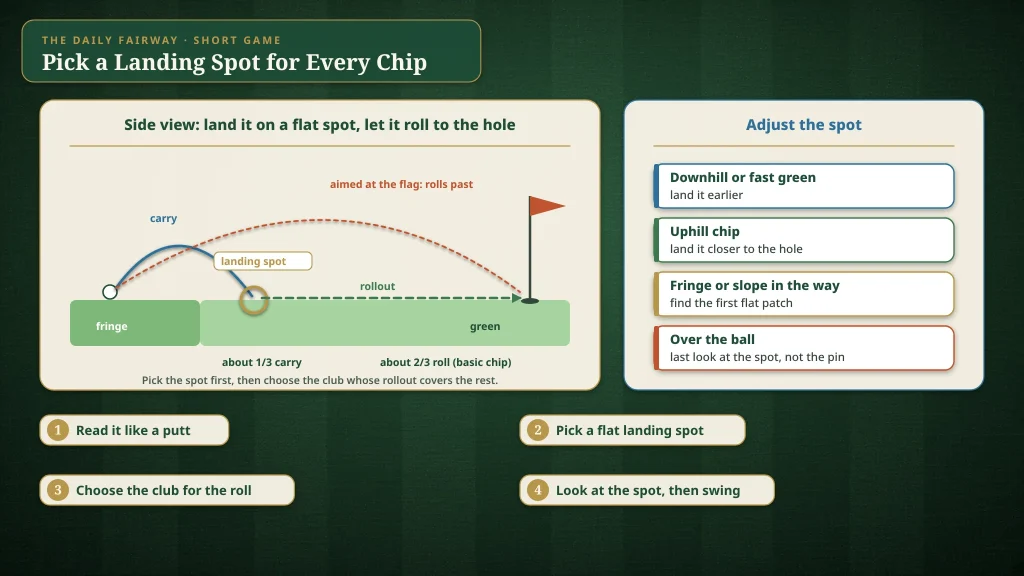
Most chips that race past the hole or come up short were aimed at the flag, not at the ground. Before you choose a club, pick the exact spot on the green where you want the ball to land, then let the club's rollout carry it the rest of the way. Choose a flat patch a few feet onto the putting surface when you can, because the fringe, a slope or the crest of a ridge makes the first bounce hard to predict. On a downhill or fast green, land it earlier; on an uphill chip, you can land it closer to the hole. Teaching pro Christina Ricci says most players pick a spot but then look at the flag as they take the club back, so the ball lands at the hole and rolls by. Two-time PGA Tour winner Gabriel Hjertstedt reads his chips like putts and even drops a leaf or towel on his landing spot in practice. A good starting point from LPGA teacher Kellie Stenzel: land a basic chip about one-third of the way to the hole. Over the ball, your last look should be the spot, not the pin.
 Quick · 1 min Short Game
Chip Softly With the Hinge-and-Hold Method
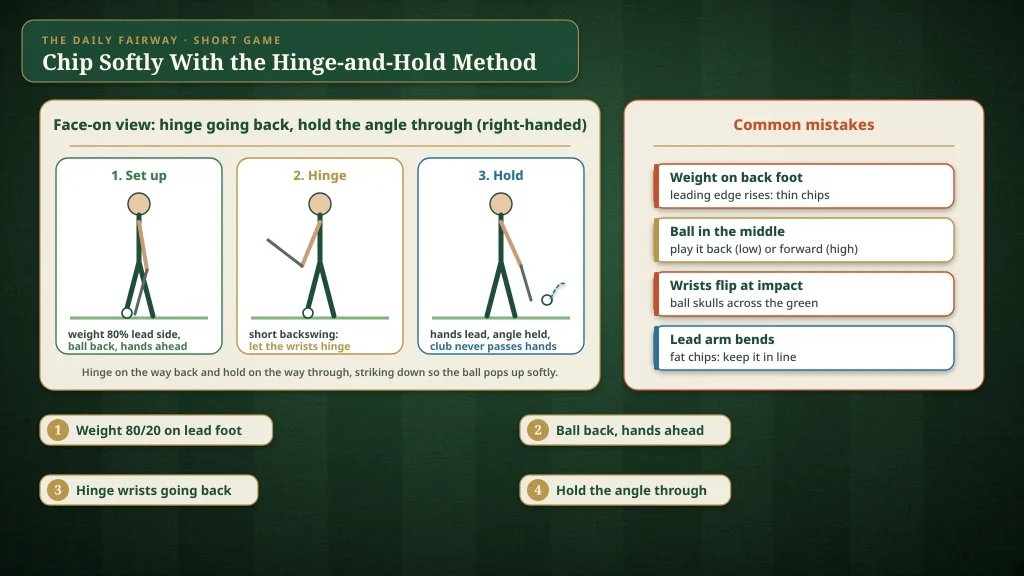
If your chips come off thin and race across the green, or you chunk them when the pressure is on, try the method Phil Mickelson calls the only way to chip: hinge and hold. It keeps the leading edge down and uses a descending strike to pop the ball up softly. Here's how to do it (written for a right-handed golfer).
 Quick · 1 min Short Game
Hit an Uphill Bunker Shot That Reaches the Hole
An uphill lie in a greenside bunker looks easy because the slope seems to help the ball up. But it catches a lot of golfers out. If you set up like a normal bunker shot, the club digs into the slope and the ball pops up and lands short. If you lean back and try to lift it, you can blade it over the green. Here's how to set up so you can make your normal bunker swing (written for a right-handed golfer).
 Quick · 1 min Short Game
Pitch Over a Bunker to a Short-Sided Pin
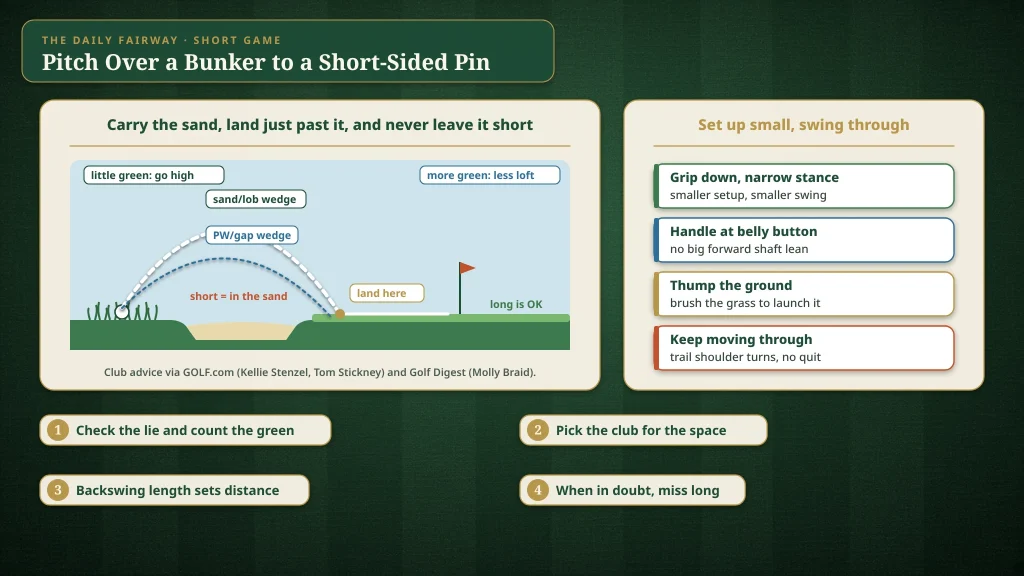
Few greenside shots scare golfers like this one: your ball is in the rough, a bunker sits between you and the green, and the pin is cut just past the bunker with very little green to land on. Hit it a little short and you're in the sand. Hit it a little long and you're putting from 30 feet. The good news is that this shot gets much easier when you choose the right club, set up for a smaller swing and commit to clearing the sand. Here's a step-by-step plan (written for a right-handed golfer).
 Quick · 1 min Short Game
Hit a Downhill Bunker Shot Without Blading It
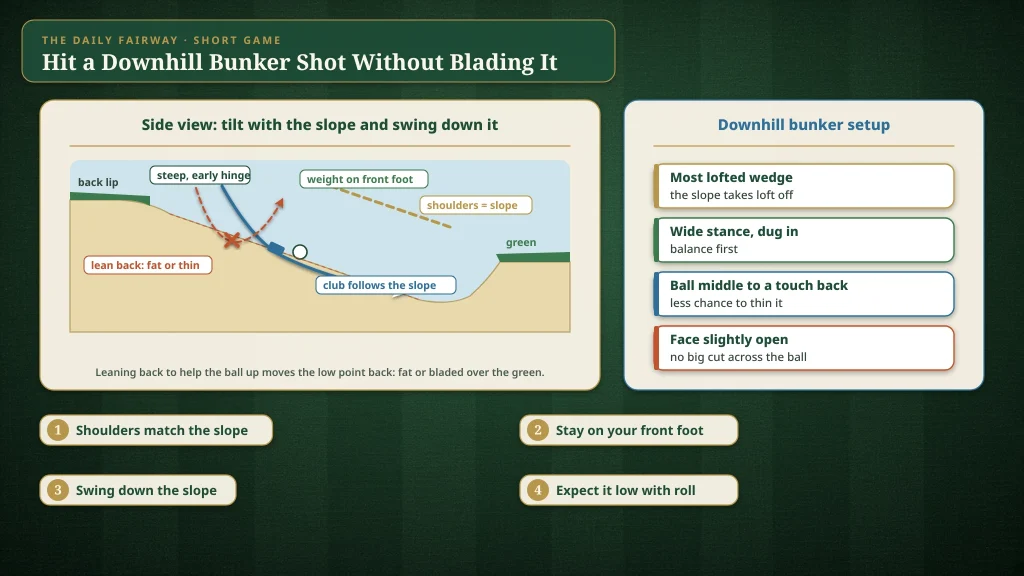
Your ball has rolled to the back of a greenside bunker and stopped on the downslope, with the green sloping away from you on the other side of the lip. This is one of the hardest shots in golf, because the slope takes loft off the club and moves the low point of your swing. Most bad results come from one mistake: leaning back to try to help the ball up. That makes the club hit the sand too early or catch the ball thin and send it screaming over the green. Here's how to play it (written for a right-handed golfer).
 Quick · 1 min Short Game
Belly a Wedge When Your Ball Sits Against the Collar
Your approach rolls just through the green's edge and stops against the collar, the strip where the short fringe meets the taller rough. The ball sits on short grass, but the grass behind it is thick. A normal chip catches that grass before the ball, and so does a putter, which can snag on the backswing, twist the face and come up way short. The bellied wedge solves both problems. You strike the middle of the ball with the leading edge of a wedge, so the club never has to go through the thick grass, and the ball rolls like a putt. GOLF.com teacher Parker McLachlin calls it a shot that sits between a bump-and-run and an off-green putt. Here's how to play it (written for a right-handed golfer).
 Quick · 1 min Short Game
Hit Out of Wet, Firm Bunker Sand
After a soaking rain, or in a bunker that's thin on sand, the surface can feel more like a sidewalk than a beach. If you use your normal splash shot there, the wide sole of your wedge bounces off the firm sand and catches the middle of the ball, and the shot rockets over the green or slams into the lip. Golf Digest compares firm sand to hitting off a cart path: the club wants to bounce, not dig. These adjustments (written for a right-handed golfer) turn it into a shot you can control.
 Quick · 1 min Short Game
Chip With Your Hybrid
When your ball sits just off the green in fuzzy fringe or on tight, grabby grass, a wedge chip can catch the turf and a putter can bounce and skid offline. A hybrid sits between the two. Its loft (usually about 17 to 27 degrees) gets the ball a few inches in the air over the fringe, and its smooth, wide sole won't dig. Then the ball rolls out like a putt. Butch Harmon and GOLF Top 100 teachers use it as a go-to shot when there's plenty of green to work with.
 Quick · 1 min Short Game
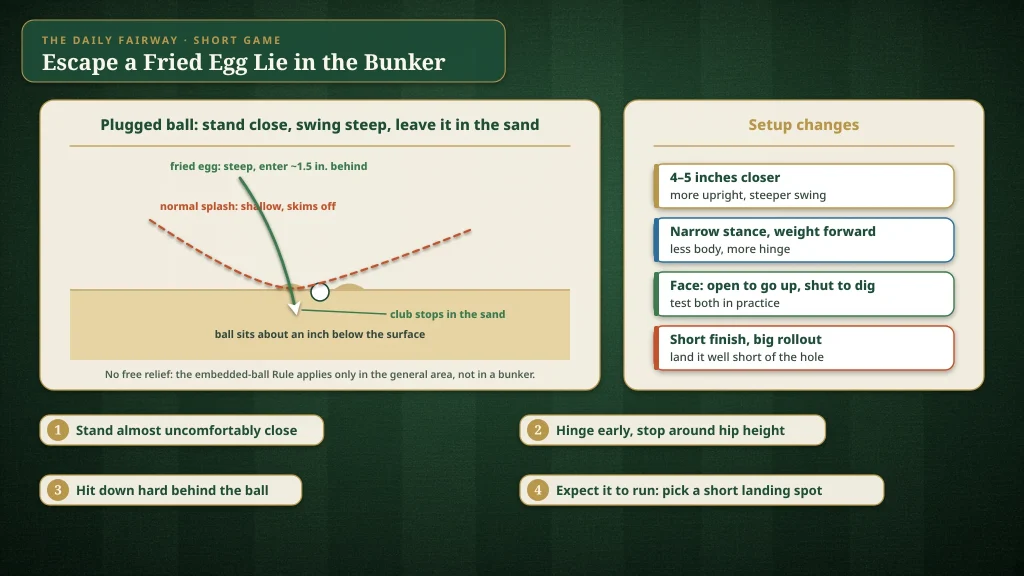
Escape a Fried Egg Lie in the Bunker
Your ball has plugged in the sand with a crater around it, the classic fried egg. Your normal splash shot won't work here: the open, shallow swing that skims under a ball sitting up will bounce off the sand and send this one rolling a few feet or skulling over the green. The ball is sitting below the surface, so you need a steeper swing that digs beneath it. And no, you don't get free relief: the embedded-ball Rule only applies in the general area, not in a bunker. Here's how to get it out in one swing.
 Quick · 1 min Short Game
Beat the Chipping Yips
Few things in golf feel worse than standing over a simple chip and having your hands jerk, stab or freeze, then watching the ball skull across the green or move two feet. The chipping yips can hit anyone; GOLF.com notes that even Tiger Woods struggled with them in 2015 before bouncing back. The Mayo Clinic describes the yips as sudden, uncontrolled movements of the wrist or hand. For some golfers they come from performance anxiety, and for others from focal dystonia, a nervous-system condition in which muscles contract without control during a specific task; anxiety makes either kind worse. The encouraging news is that changing how you perform the movement often helps, and that's exactly what the fixes below do.