 The Daily
Pitch Over a Bunker to a Short-Sided Pin
Disclosure: Some links on this page are affiliate links. If you buy through them we may earn a commission at no extra cost to you. As an Amazon Associate I earn from qualifying purchases. Learn more.
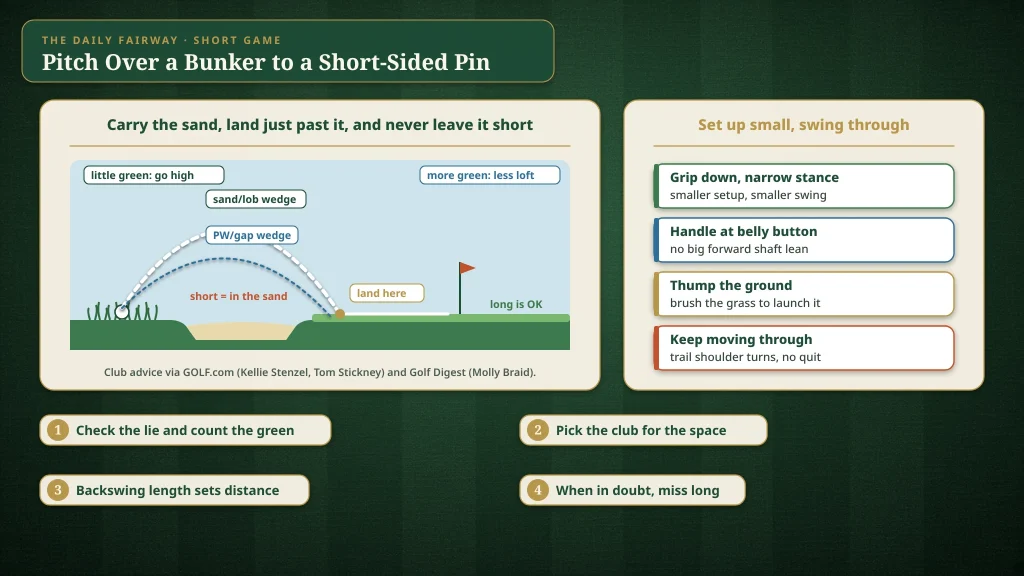
Few greenside shots scare golfers like this one: your ball is in the rough, a bunker sits between you and the green, and the pin is cut just past the bunker with very little green to land on. Hit it a little short and you’re in the sand. Hit it a little long and you’re putting from 30 feet. The good news is that this shot gets much easier when you choose the right club, set up for a smaller swing and commit to clearing the sand. Here’s a step-by-step plan (written for a right-handed golfer).
🛒 Gear that helps with this: Cleveland RTX ZipCore Wedge — A spin-focused wedge offered in multiple lofts and grinds, so you can match bounce to your turf.
How to do it
1. Check the lie first. A ball sitting up in the rough lets you slide the club under it and hit a high, soft pitch. A ball sitting down in thick grass is harder to control and comes out with less spin, so play for the middle of the green and accept a longer putt. Hovering the club behind the ball instead of pressing it down also keeps you from moving the ball by accident.
2. Count how much green you have. Pace off the distance from the far edge of the bunker to the hole. If there are only a few steps of green, you need a high, soft shot. If there’s more room, you can play a lower pitch that lands short and rolls.
3. Choose the club that fits the space. With very little green, use your sand or lob wedge. GOLF.com Top 100 Teacher Kellie Stenzel suggests a lofted club with plenty of bounce so the ball gets up quickly and stops soon after it lands. With more green to work with, Golf Digest Best Young Teacher Molly Braid says many golfers are better off with a pitching or gap wedge and a normal pitching stroke. Bunkers are down in the ground, so the ball doesn’t need to go as high as you think, and less loft is more forgiving when it rolls out.
4. Set up small. Grip down an inch or two and narrow your stance. Stenzel notes that a smaller setup naturally leads to a smaller swing, which makes distance easier to control. Put a little more weight on your front foot, play the ball in the middle of your stance and keep the handle pointing about at your belly button instead of leaning it far forward. That lets the loft and bounce do their jobs.
5. Open the face only if you need to. With the right club, most amateurs don’t need to open the face. If you need extra height for a very tight pin, open it slightly before you take your grip, then aim your body a little left so the ball still starts on line.
6. Make a practice swing that brushes the grass. Stenzel says the club should hit the ground and make a little thump. A swing that only skims the top of the grass won’t send the ball high enough to clear the bunker. Take two practice swings beside the ball until you feel that contact.
🛒 Many golfers practice this with Frogger Amphibian Golf Towel — A wet/dry towel that clips to your bag. Clean grooves before every wedge for more spin.
7. Control distance with the size of your backswing. Pick a backswing length that matches the shot, such as hip high for a short pitch. Keep your grip pressure light so the clubhead can release under the ball.
8. Keep moving through the ball. GOLF Top 100 Teacher Tom Stickney says the biggest key is to keep moving and keep your trail shoulder turning through the shot. Slowing down out of fear is what leaves the ball in the bunker or sends it skulled across the green. Finish with your chest facing the target.
9. Pick a landing spot past the bunker. Choose a spot on the green, a few feet past the edge of the bunker, and focus on landing the ball there. With a high, soft shot, the ball will roll a little after it lands. With less loft, it will roll more, so your landing spot moves closer to the edge.
10. When in doubt, miss long. Stenzel’s advice is simple: if you’re short, you’ll probably be in the bunker. A 15-foot putt is much better than another shot from the sand, so plan to finish past the hole rather than short of it.
Practice it: At a practice green with a bunker, drop five balls in the rough behind it. Hit one with a lob or sand wedge, one with a gap wedge and one with a pitching wedge, then see which club leaves you closest for each pin position. You’ll learn which club to trust when you’re short-sided on the course.
Course strategy: The best fix is to avoid this shot. On approach shots, aim toward the fat part of the green, away from pins tucked behind bunkers. When you do miss, a pitch to the center of the green is often the smart play for higher handicappers.
Top picks for this tip
- 1
Cleveland RTX ZipCore Wedge
Clubs
A spin-focused wedge offered in multiple lofts and grinds, so you can match bounce to your turf.
- 2
Frogger Amphibian Golf Towel
Accessories
A wet/dry towel that clips to your bag. Clean grooves before every wedge for more spin.
- 3
Titleist Pro V1 Golf Balls
Balls
A tour-level urethane ball that grabs on chips and pitches. Worth it once your contact is consistent.
Watch it
Rickie Fowler on How To Hit a Chip Shot Over a Bunker | Butch Harmon Golf Lessons | Golf Digest — Golf Digest
Sources & further reading
- Pitching over a bunker? 10 ways to see consistent success · GOLF.com
Kellie Stenzel: use loft and bounce, a smaller setup for a smaller swing, hit the ground and plan to miss long rather than short. - Make this club selection change when you have to chip over a greenside bunker · Golf Digest
Molly Braid: with some green to work with, a pitching or gap wedge with a pitching stroke is more forgiving than a big lob-wedge swing. - The ‘biggest key’ for getting up and down when short-sided · GOLF.com
Tom Stickney: keep moving and keep the trail shoulder turning through a short-sided pitch so you don’t decelerate.
FAQ
What is the "Pitch Over a Bunker to a Short-Sided Pin" golf tip about?
Few greenside shots scare golfers like this one: your ball is in the rough, a bunker sits between you and the green, and the pin is cut just past the bunker with very little green to land on. Hit it a little short and you’re in the sand. Hit it a little long and you’re putting from 30 feet. The good news is that this shot gets much easier when you choose the right club, set up for a smaller swing and commit to clearing the sand. Here’s a step-by-step plan (written for a right-handed golfer).
How do I put it into practice?
Check the lie first. A ball sitting up in the rough lets you slide the club under it and hit a high, soft pitch. A ball sitting down in thick grass is harder to control and comes out with less spin, so play for the middle of the green and accept a longer putt. Hovering the club behind the ball instead of pressing it down also keeps you from moving the ball by accident.
What’s the key takeaway?
Course strategy: The best fix is to avoid this shot. On approach shots, aim toward the fat part of the green, away from pins tucked behind bunkers. When you do miss, a pitch to the center of the green is often the smart play for higher handicappers.
Ready to practice this? Our top pick for this tip is the Cleveland RTX ZipCore Wedge.
