 The Daily
Shotmaking
 Quick · 1 min Shotmaking
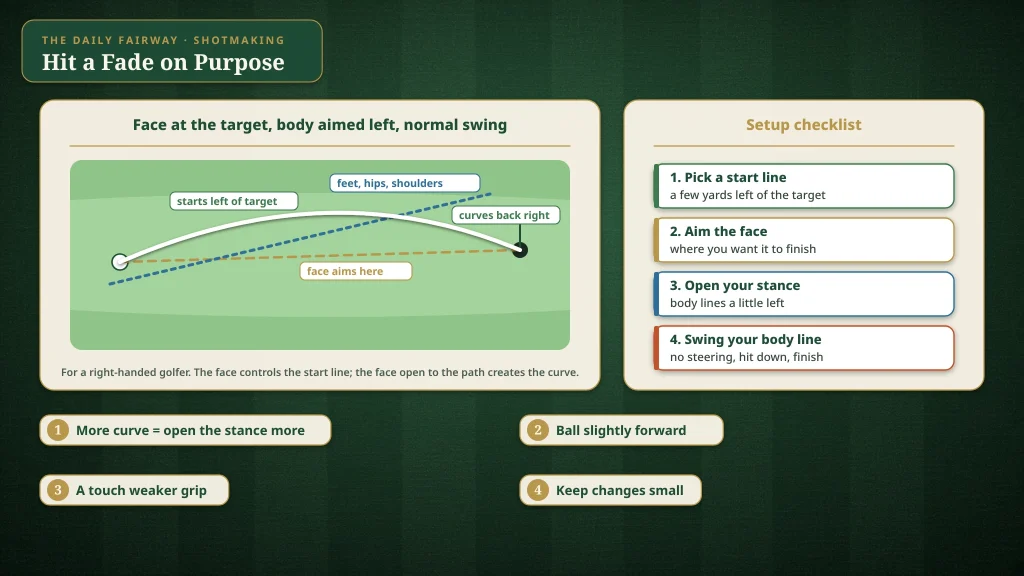
Hit a Fade on Purpose
A fade is a shot that starts a little left of the target and curves gently back to the right (for a right-handed golfer). It's a great shot when the pin is tucked on the right side of the green or the fairway bends right, and many tour players use it as their stock shot because it lands softly and is easy to control. You don't need a new swing to hit one. You need a slightly different setup. Here's how (written for a right-handed golfer).
 Quick · 1 min Shotmaking
Play a Mud Ball With More Club and a Lower Flight
After a rainy week, your drive splashes down in the fairway and comes up with a clump of mud stuck to one side. Unless your course has preferred lies (lift, clean and place) in effect, you have to play it as it lies, mud and all. A mud ball is never fully predictable, but you can make an educated guess about what it will do and set up a shot that keeps the damage small. Here's how (written for a right-handed golfer).
 Quick · 1 min Shotmaking
Hit Cleanly Off Pine Straw
Missing the fairway into the pines often leaves the ball sitting on a bed of loose needles. It looks playable, but pine straw is slippery to stand on and gives way under the club. Ground it behind the ball and the needles can shift, the ball can move, and the club tends to slide under the ball or catch the straw first. Pros treat it like a firm bunker shot: stable feet, ball first and no ground contact behind it.
 Quick · 1 min Shotmaking
Grip Down an Inch for In-Between Yardages
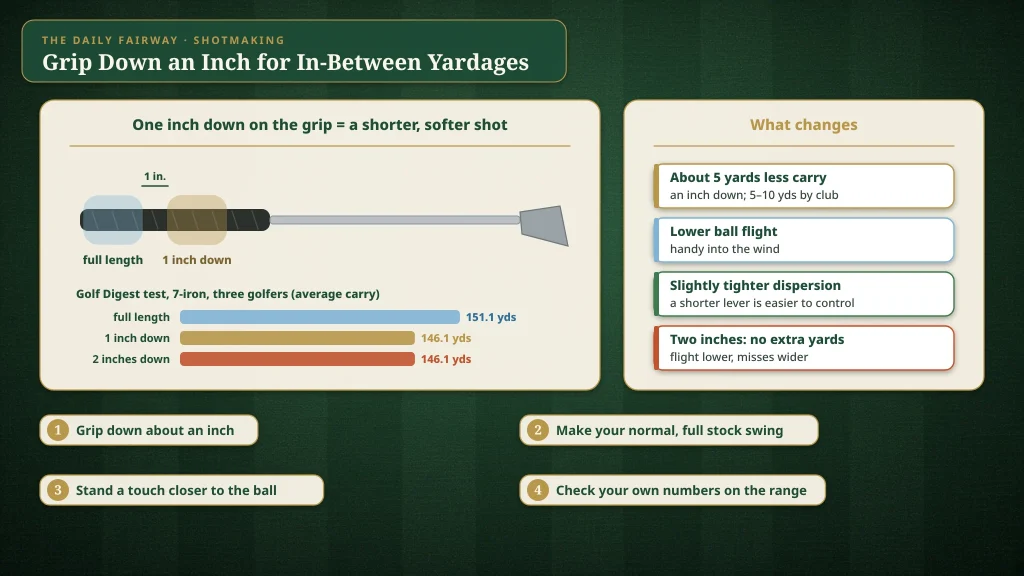
Stuck between clubs? Instead of muscling the shorter one or making an awkward three-quarter swing with the longer one, grip down about an inch on the longer club and make your normal, full stock swing. A shorter grip makes the club a shorter lever, so it swings a little slower and the ball flies a little shorter and lower. When Golf Digest tested it with three golfers hitting 7-irons, gripping down one inch took off exactly 5 yards of carry on average (151.1 to 146.1 yards), lowered the peak height and tightened the misses slightly. Golf Digest Best Teacher Joe Plecker says to expect about 5 to 10 yards less depending on the club. Don't overdo it: at two inches down, the testers lost no more distance than at one inch, and their shots went farther offline, because the shorter club sits more upright and the face can point left. Stand a touch closer so you're not reaching, keep your tempo the same, and check your own numbers on the range before you trust it on the course.
 Quick · 1 min Shotmaking
Read the Lie Before You Pull a Club
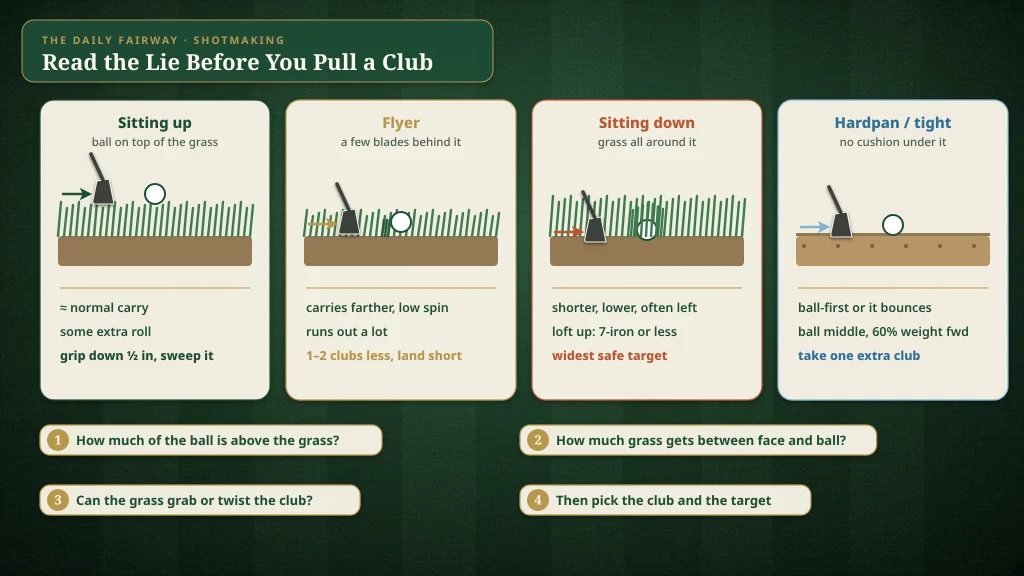
Most golfers pick a club from the yardage and then try to make the lie cooperate. Better players do it the other way around: the lie makes the first decision. As GOLF Top 100 Teacher to Watch Grayson Zacker puts it, the main thing to judge is how much grass will get between the clubface and the ball at impact. The answer changes how far the ball carries, how much it spins and rolls, and sometimes whether the green is a realistic target at all.
 Medium · 3 min Shotmaking
The Low Punch Shot
A low punch keeps the ball under tree limbs and cuts through wind when a stock flight would balloon. It is a damage-control shot first: get back in play, then chase a hero gap.
 Medium · 3 min Shotmaking
Hitting From a Divot
A ball sitting in a divot is lower than normal, so you need a steeper, downward strike.
 Medium · 3 min Shotmaking
Fairway Bunker Shots
From a fairway bunker the goal is clean, ball-first contact. Catch even a little sand first and the ball goes nowhere.
 Quick · 1 min Shotmaking
Ball Below Your Feet
When the ball sits below your feet, flex your knees more, stay down through the shot and aim a little left. It tends to fly right.
 Quick · 1 min Shotmaking
Ball Above Your Feet
When the ball sits above your feet, it tends to fly left (for right-handers). Grip down and aim a little right.