 The Daily
Read the Lie Before You Pull a Club
Disclosure: Some links on this page are affiliate links. If you buy through them we may earn a commission at no extra cost to you. As an Amazon Associate I earn from qualifying purchases. Learn more.
Most golfers pick a club from the yardage and then try to make the lie cooperate. Better players do it the other way around: the lie makes the first decision. As GOLF Top 100 Teacher to Watch Grayson Zacker puts it, the main thing to judge is how much grass will get between the clubface and the ball at impact. The answer changes how far the ball carries, how much it spins and rolls, and sometimes whether the green is a realistic target at all.
🛒 Gear that helps with this: Alignment Sticks (2-pack) — The cheapest, most useful practice tool in golf: check aim, ball position and gate drills.
How to do it
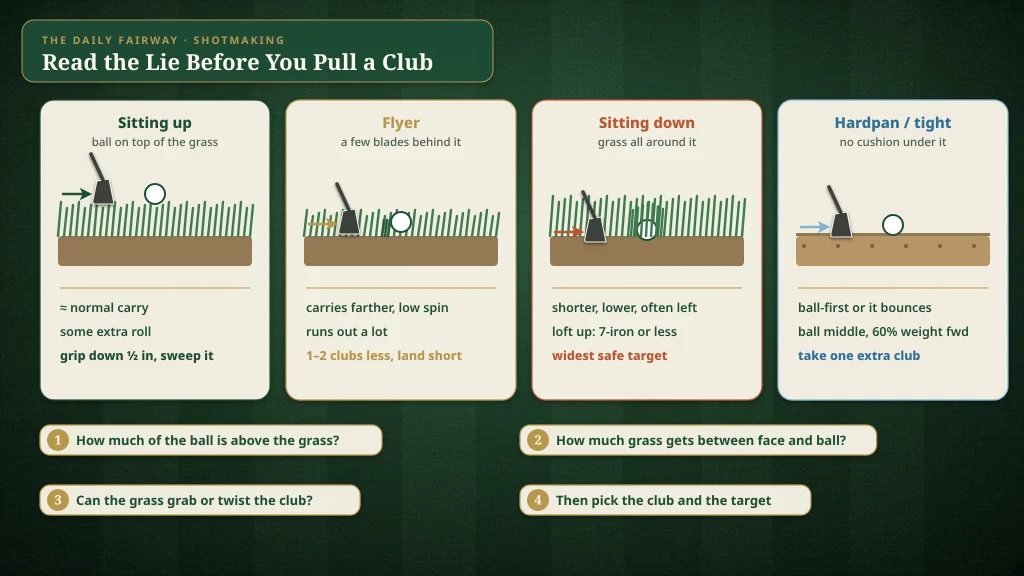
1. Look before you grab the rangefinder. Walk up and answer three questions: how much of the ball sits above the grass, how much grass will be trapped between the face and the ball, and can you make a normal swing without the grass grabbing the club? Set the club lightly behind the ball to gauge how high it sits, without pressing down, since pressing the grass down to improve your lie breaks Rule 8.1. Notice which way the grass grows too: grass growing toward the target lets the club through, while grass growing against you grabs it.
2. Sitting up (a fluffy, almost teed-up lie). Little grass gets behind the ball, so expect close to your normal distance. The danger is sliding underneath it or catching it high on the face. Grip down about half an inch, keep the ball near its usual position, and make a smooth, shallower swing; stay in your posture instead of dipping to get under it. Even a little grass or moisture can cut spin, so allow for some extra release. With the ball sitting this high, a hybrid or fairway wood can be a good option.
3. The flyer (partly down, a few blades behind the ball). This is the sneaky one. A few blades get between the face and the ball, cover the grooves and strip spin, so the ball comes out hot with a knuckling flight, carries farther and runs out much more than usual. Golf Digest Best in State teacher Nick Bova suggests one or two clubs less, and Zacker at least one less. Flyers are most common in light to moderate rough and in dry conditions. Land it short of the flag, often on the front edge, and let it release.
🛒 Many golfers practice this with Bushnell Tour V6 Rangefinder — A laser rangefinder that vibrates when it locks onto the pin, so you know your exact carry number.
4. Sitting down (all the way in). Now there’s no way to reach the back of the ball without a lot of grass in between. The grass slows the club and twists the face, so the shot usually comes out shorter, lower and often left. Take enough loft to get through it; Zacker says never use anything longer than a 7-iron here. Play the ball about one ball farther back, start with a little more pressure on your lead foot, and grip firmly enough that the grass can’t twist the face. Then stop asking whether you can reach the flag and pick the widest safe area. A simple 25-yard pitch beats forcing a long iron that only advances 40 yards.
5. Tight lies and hardpan. Bare or firm ground has the opposite problem: no cushion, so if you catch the ground first the club bounces into the ball. GOLF Top 100 Teacher Jim Murphy says to dig your feet in for solid footing, play the ball in the middle of your stance and set at least 60 percent of your weight on your front foot, keeping it there as you swing so you hit ball first. Swing smoothly, stay balanced and take an extra club just in case. From firm, tight fairways with a mid or long iron, Nick Price prefers a lower three-quarter shot that lands and releases rather than trying to hit it high and soft.
Practice plan: Find a practice area where you can safely hit from rough and drop nine balls: three on clean, light lies, three sitting up in fluffy grass and three sitting down. Before each shot, say out loud what you expect for launch, carry and roll, choose your setup from the lie, then compare the result with your prediction. Hit all nine with the same 8-iron and write down how much shorter or longer each lie went. Add a few shots from a firm, bare patch if your practice area allows it. On the course, make reading the lie the first step of your pre-shot routine, before you look at the yardage.
Top picks for this tip
- 1
Alignment Sticks (2-pack)
Training Aids
The cheapest, most useful practice tool in golf: check aim, ball position and gate drills.
- 2
Bushnell Tour V6 Rangefinder
Rangefinders
A laser rangefinder that vibrates when it locks onto the pin, so you know your exact carry number.
- 3
Garmin Approach S44 GPS Watch
Rangefinders
A GPS watch with front, middle and back green distances, plus hazard info on your wrist.
Rangefinder vs. GPS watch
| Product | Type | What it’s good for | |
|---|---|---|---|
| Bushnell Tour V6 Rangefinder | Rangefinders | Laser rangefinder with pin lock vibration. | Amazon → |
| Garmin Approach S44 GPS Watch | Rangefinders | GPS watch with course maps and green distances. | Amazon → |
We don’t list prices or star ratings here because they change; check Amazon for current details.
Watch it
How to hit irons from the rough — Golf.com
Sources & further reading
- A go-to guide for reading tricky lies in the rough, per a top teacher · GOLF.com
Grayson Zacker: judge how much grass gets between face and ball; sitting up plays normal, partly down risks a flier (take one less), sitting down comes out short and low (nothing longer than a 7-iron). - How to Play Iron Shots From Tricky Lies, Inspired by Wyndham Clark · PGA of America
Let the lie make the first decision: three questions before choosing a club, setups for clean, fluffy and buried lies, and a nine-ball prediction drill. - Lie Detector: The flyer lie · Golf Digest
Nick Bova: flyers happen in light to moderate rough and dry conditions; the ball comes out hot with little spin, so take one or two clubs less and expect roll. - Hitting from the hardpan isn’t impossible. Here’s the secret · GOLF.com
Jim Murphy: dig in for footing, ball in the middle of the stance, at least 60 percent of your weight forward and kept there for ball-first contact; take an extra club. - Nick Price: How To Hit Better Irons From Tight Lies · Golf Digest
From firm, tight lies Price plays the ball farther back and favors a lower three-quarter knockdown that releases instead of a high, soft iron.
FAQ
What is the "Read the Lie Before You Pull a Club" golf tip about?
Most golfers pick a club from the yardage and then try to make the lie cooperate. Better players do it the other way around: the lie makes the first decision. As GOLF Top 100 Teacher to Watch Grayson Zacker puts it, the main thing to judge is how much grass will get between the clubface and the ball at impact. The answer changes how far the ball carries, how much it spins and rolls, and sometimes whether the green is a realistic target at all.
How do I put it into practice?
Look before you grab the rangefinder. Walk up and answer three questions: how much of the ball sits above the grass, how much grass will be trapped between the face and the ball, and can you make a normal swing without the grass grabbing the club? Set the club lightly behind the ball to gauge how high it sits, without pressing down, since pressing the grass down to improve your lie breaks Rule 8.1. Notice which way the grass grows too: grass growing toward the target lets the club through, while grass growing against you grabs it.
What’s the key takeaway?
Practice plan: Find a practice area where you can safely hit from rough and drop nine balls: three on clean, light lies, three sitting up in fluffy grass and three sitting down. Before each shot, say out loud what you expect for launch, carry and roll, choose your setup from the lie, then compare the result with your prediction. Hit all nine with the same 8-iron and write down how much shorter or longer each lie went. Add a few shots from a firm, bare patch if your practice area allows it. On the course, make reading the lie the first step of your pre-shot routine, before you look at the yardage.
Ready to practice this? Our top pick for this tip is the Alignment Sticks (2-pack).
