 The Daily
Hit Your Long Irons Solid
Disclosure: Some links on this page are affiliate links. If you buy through them we may earn a commission at no extra cost to you. As an Amazon Associate I earn from qualifying purchases. Learn more.
Long irons (the 3-, 4- and 5-iron) are the hardest clubs in the bag for most golfers. They have long shafts and very little loft, so it’s easy to try to help the ball up and end up topping it, catching it thin or hitting it low and weak. The good news is that a few setup changes and a smoother swing make a big difference. Here’s a step-by-step plan (written for a right-handed golfer).
🛒 Gear that helps with this: Rukket Haack Practice Net — A backyard hitting net for full swings, so you can groove a move between range visits.
How to do it
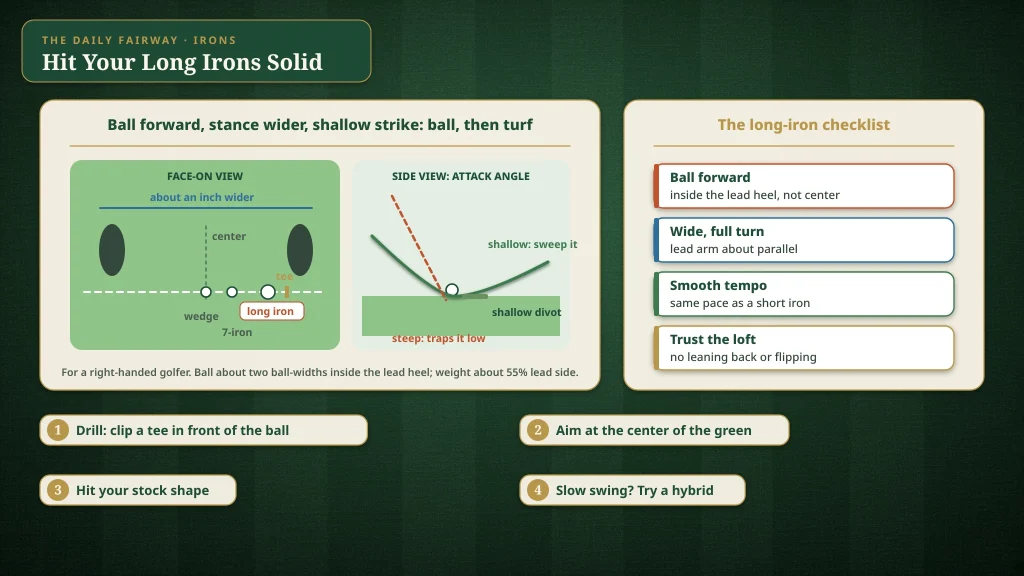
1. Understand the strike you need. A long iron still needs a slightly downward strike: ball first, then a shallow bit of turf. Golf Monthly Top 50 Coach Gary Munro says hitting down gives you more compression and launch, which means more ball speed and distance. But it’s a shallower blow than a wedge. Tom Watson describes it in Golf Digest as more of a sweep than a dig.
2. Move the ball forward. Ball position is the most common problem. Munro suggests about two ball-widths inside your lead heel. GOLFTEC’s guide on GOLF.com says just inside the lead foot’s instep: forward of center, but not as far forward as a driver. If the ball is too far back, you’ll hit it low and it will only fly about as far as a mid-iron. Lay a club on the ground as a check when you practice.
3. Widen your stance a little. A longer club means a longer swing, and you need more stability to create speed. GOLFTEC suggests going about an inch wider than your 7-iron stance. Munro builds his stance from feet together, then takes a big step with the trail foot and a small step with the lead foot.
4. Set your weight slightly forward. Start with your weight just favoring your lead side, around 55 percent, as Munro suggests. Keep the shaft fairly neutral rather than pressing your hands well ahead the way you might with a wedge. That helps produce a shallower angle of attack.
5. Make a wide, full turn. Keep your lead arm fairly straight and let your wrists hinge gradually. Munro wants the lead arm to reach about parallel to the ground with a full shoulder turn. Speed comes from that wide turn, not a fast takeaway.
6. Don’t swing harder. When the ball won’t get up, golfers tend to swing harder, and contact gets worse. GOLFTEC’s coach says to focus on a smooth tempo so you find the center of the face. Golf Digest’s tour technique advice is the same: don’t overswing, and swing it like a short iron. That keeps your timing in order.
7. Stay shallow coming down. A steep downswing traps the ball and makes it fly low with less height to stop on the green. Feel the club come in on a shallower approach and sweep the ball off the turf, with your arms extending through impact.
🛒 Many golfers practice this with SKLZ Gold Flex Swing Trainer — A weighted, flexible shaft that punishes a rushed transition and builds smooth tempo.
8. Trust the loft. Don’t lean back or flip your wrists to add loft. That causes the thin and topped shots you’re trying to avoid. With the ball in the right place and a full turn, the club will launch it.
9. Drill: collect the tee. From Munro: place a tee in the ground about two ball-widths in front of the ball, on your target line. Hit the ball and try to clip the tee out of the ground on the way through. You can only do that if you strike the ball first and keep moving forward.
10. Pick smart targets. A 4-iron from 200 yards isn’t a birdie club. Tour pro Michael Kim told GOLF.com his plan with a long iron is to hit his stock shot at the center of the green. Hit your normal shot shape and stay away from big trouble.
11. Consider a hybrid. Long irons need speed to launch high. Watson says if you don’t swing at least 95 mph, replace your long irons with a hybrid or two. There’s no shame in it: hybrids are easier to launch and more forgiving from the rough.
Practice it: Spend one session on just long irons. Start with half swings and the tee drill, then build to full swings with the same smooth tempo. Check your ball position with a club on the ground every few shots.
On the course: Before each long-iron shot, pick the center of the green, check your ball position and make a smooth, full swing. Solid contact matters more than swing speed.
Top picks for this tip
- 1
Rukket Haack Practice Net
Training Aids
A backyard hitting net for full swings, so you can groove a move between range visits.
- 2
SKLZ Gold Flex Swing Trainer
Training Aids
A weighted, flexible shaft that punishes a rushed transition and builds smooth tempo.
- 3
Alignment Sticks (2-pack)
Training Aids
The cheapest, most useful practice tool in golf: check aim, ball position and gate drills.
Watch it
How to Hit with Long Irons | Golf Channel — Golf Channel
Sources & further reading
- Ball-striking masterclass: long irons, fairway woods and hybrids · Golf Monthly
Gary Munro: ball two ball-widths inside the lead heel, wider stance, about 55% weight on the lead side, a full shoulder turn and a downward strike; clip a tee in front of the ball. - Hit your long irons pure with these 5 keys from GOLFTEC · GOLF.com
Play the ball just inside the lead instep, widen your stance about an inch beyond a 7-iron, and favor smooth tempo over swinging harder. - Tom Watson: Stop topping your long irons · Golf Digest
Ball slightly forward, a shallow arc that sweeps rather than digs; golfers swinging under about 95 mph should consider hybrids. - Tour technique: Secrets to pure long irons · Golf Digest
Pick a conservative target, don’t overswing, swing it like a short iron and keep a shallow approach with good extension. - Michael Kim’s keys to hitting long irons · GOLF.com
Hit your stock shot at the center of the green and use forgiving equipment.
FAQ
What is the "Hit Your Long Irons Solid" golf tip about?
Long irons (the 3-, 4- and 5-iron) are the hardest clubs in the bag for most golfers. They have long shafts and very little loft, so it’s easy to try to help the ball up and end up topping it, catching it thin or hitting it low and weak. The good news is that a few setup changes and a smoother swing make a big difference. Here’s a step-by-step plan (written for a right-handed golfer).
How do I put it into practice?
Understand the strike you need. A long iron still needs a slightly downward strike: ball first, then a shallow bit of turf. Golf Monthly Top 50 Coach Gary Munro says hitting down gives you more compression and launch, which means more ball speed and distance. But it’s a shallower blow than a wedge. Tom Watson describes it in Golf Digest as more of a sweep than a dig.
What’s the key takeaway?
On the course: Before each long-iron shot, pick the center of the green, check your ball position and make a smooth, full swing. Solid contact matters more than swing speed.
Ready to practice this? Our top pick for this tip is the Rukket Haack Practice Net.
