 The Daily
Make More Short Putts With the Clock Drill
Disclosure: Some links on this page are affiliate links. If you buy through them we may earn a commission at no extra cost to you. As an Amazon Associate I earn from qualifying purchases. Learn more.
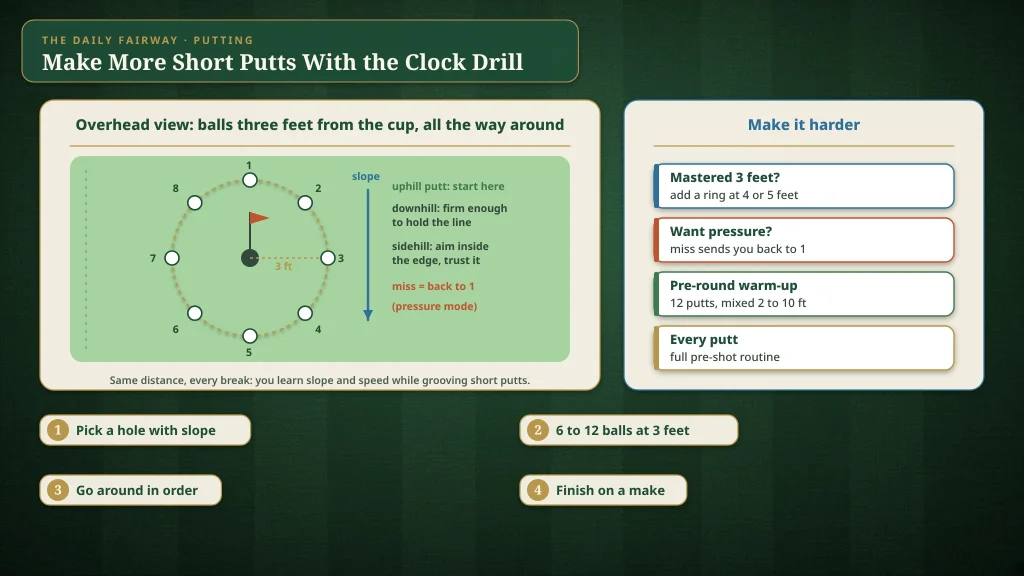
Short putts decide more scores than any other shot, and the classic clock drill is how tour players groove them. You place balls in a circle around the hole and putt them in one by one, so you face uphill, downhill and both sidehill breaks from the same distance. Here’s how to set it up and make it count.
🛒 Gear that helps with this: Alignment Sticks (2-pack) — The cheapest, most useful practice tool in golf: check aim, ball position and gate drills.
How to do it
1. Pick the right hole. Choose a cup on the practice green with a little slope around it. A perfectly flat hole only gives you straight putts; mild slope gives you a mix of breaks, which is what you’ll see on the course.
2. Start at three feet. Place six to 12 balls (or tees) evenly around the cup, each about three feet away, like the numbers on a clock. The PGA of America’s version uses four tees at three feet; GOLF.com Top 100 Teacher Gia Liwski recommends three to five feet as a pre-round warm-up.
3. Work your way around. Start with the straightest putt, usually the uphill one, and go around the clock in order. Use your full pre-shot routine on every putt. The Sand Trap suggests trusting your instinct on these short ones rather than over-reading them.
4. Watch what each putt tells you. Liwski says keeping every ball the same distance gives you a clear picture of slope and speed: you’ll quickly see which side of the hole breaks most and how firmly you need to hit downhill putts to hold the line.
🛒 Many golfers practice this with PuttOut Pressure Putt Trainer — A compact target that only keeps putts hit at the right speed. Great for the ladder and lag drills.
5. Add pressure. Once you can get around the circle, make the rule that a miss sends you back to the start. Golf coaches often set a target like two full laps in a row. Pressure in practice makes a three-footer on the course feel routine.
6. Move back. When three feet feels easy, add a second ring at four or five feet. For a warm-up version, Liwski suggests mixing distances around the circle, such as two feet on one putt and 10 feet on the next, to feel speed and aim.
7. Keep it short. Twelve putts is enough before a round. On a practice day, do two or three rounds of the drill, then finish on a make so you leave the green confident.
Track it: Write down how many putts in a row you made each session. Try to beat that number next time, and note which clock positions you miss most so you know which break to practice.
Top picks for this tip
- 1
Alignment Sticks (2-pack)
Training Aids
The cheapest, most useful practice tool in golf: check aim, ball position and gate drills.
- 2
PuttOut Pressure Putt Trainer
Training Aids
A compact target that only keeps putts hit at the right speed. Great for the ladder and lag drills.
- 3
Rukket Haack Practice Net
Training Aids
A backyard hitting net for full swings, so you can groove a move between range visits.
Watch it
Ep. #1 The Clock Drill – Putting Improvement Series — Back 2 Basics Golf
Sources & further reading
- Need an effective putting practice routine? Try the clock drill · GOLF.com
Gia Liwski: keep the putts three to five feet, about 12 putts, and use equal distances to read slope and speed. - Golf Tips: The Best Putting Drills to Improve Your Stroke · PGA of America
3-Foot Circle Drill: four tees about three feet from the hole; putt from each one in turn to build confidence on short putts. - Clock Putting · The Sand Trap
Six to 12 balls three feet from the hole give uphill, downhill and sidehill putts; putt them instinctively.
FAQ
What is the "Make More Short Putts With the Clock Drill" golf tip about?
Short putts decide more scores than any other shot, and the classic clock drill is how tour players groove them. You place balls in a circle around the hole and putt them in one by one, so you face uphill, downhill and both sidehill breaks from the same distance. Here’s how to set it up and make it count.
How do I put it into practice?
Pick the right hole. Choose a cup on the practice green with a little slope around it. A perfectly flat hole only gives you straight putts; mild slope gives you a mix of breaks, which is what you’ll see on the course.
What’s the key takeaway?
Track it: Write down how many putts in a row you made each session. Try to beat that number next time, and note which clock positions you miss most so you know which break to practice.
Ready to practice this? Our top pick for this tip is the Alignment Sticks (2-pack).
