 The Daily
Read the Grain on Bermuda Greens
Disclosure: Some links on this page are affiliate links. If you buy through them we may earn a commission at no extra cost to you. As an Amazon Associate I earn from qualifying purchases. Learn more.
If you play in the South or on vacation in Florida, Arizona or Myrtle Beach, you’ll putt on Bermudagrass. Its blades grow sideways as well as up, and that lean, called grain, changes how fast the ball rolls and how much it breaks. Putts roll faster down the grain and slower into it, and grain that runs across your line can nudge the ball sideways. Here’s how to read it in a few seconds.
🛒 Gear that helps with this: PuttOut Pressure Putt Trainer — A compact target that only keeps putts hit at the right speed. Great for the ladder and lag drills.
How to do it
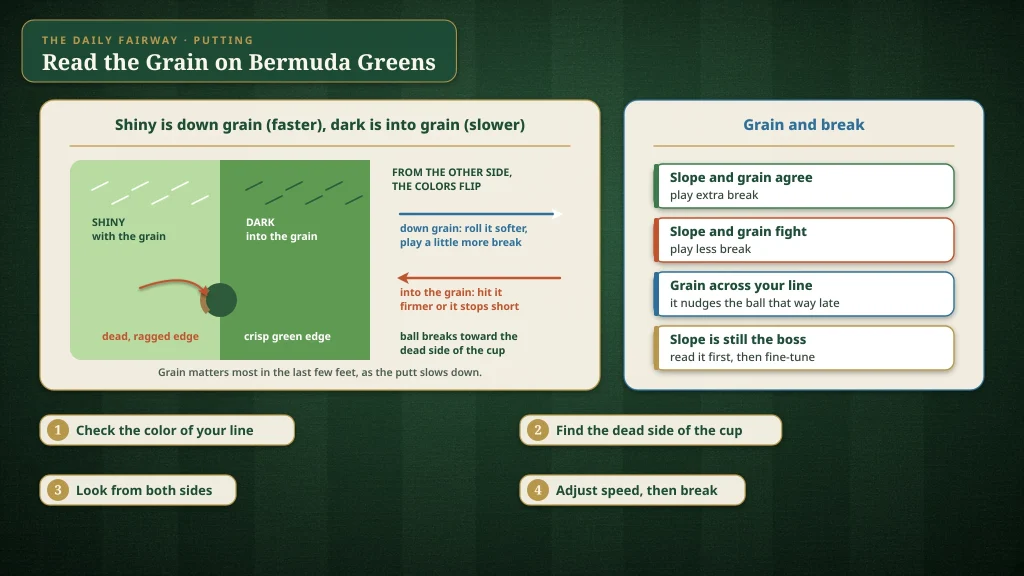
1. Check the color of the grass. Look along your line. The USGA says shiny, silvery grass means you’re putting with the grain (faster), and dark green grass means you’re putting into it (slower). Walk to the other side of the hole and the colors flip, which is a good way to confirm it.
2. Look at the edges of the cup. GOLF Top 100 Teacher to Watch Parker McLachlin says one side of most Bermuda cups looks brown, ragged and worn, while the other side has a crisp green edge. The ball will want to break toward that dead, ragged side. LPGA Tour player Marina Alex starts her read with the cup, too: the side where the grass looks grittier and less smooth shows the direction the grain is growing.
3. Adjust your speed. Down grain on shiny grass, the putt will run out more than it looks, so make a softer stroke. Into the grain on dark grass, give it a firmer hit or it will come up short. Alex notes that because you’re hitting a down-grain putt softer, you also need to play a little more break.
🛒 Many golfers practice this with Odyssey White Hot Putter — A classic soft-feel insert putter that’s helped countless golfers with distance control.
4. Adjust your break. When the grain runs across your line, it will push the ball in that direction, mostly in the last few feet as the putt loses speed. If the slope and the grain go the same way, play extra break. If they fight each other, play less. Alex warns that the grain doesn’t always run downhill, so check it on every putt, and look from both sides of the hole to confirm the color change and the cup.
5. Let the slope have the final say. The USGA notes that nobody can say for sure what sets the direction of the grain, and that slope is still the biggest factor in how a putt breaks. Read the slope first, then use the grain to fine-tune speed and break.
Practice: On the practice green, find the ragged side of a cup and roll three 10-foot putts from each of four directions around it. Notice which putts run long, which come up short and which way they drift at the end. Five minutes of this before a round will tell you how much the grain matters that day.
Top picks for this tip
- 1
PuttOut Pressure Putt Trainer
Training Aids
A compact target that only keeps putts hit at the right speed. Great for the ladder and lag drills.
- 2
Odyssey White Hot Putter
Clubs
A classic soft-feel insert putter that’s helped countless golfers with distance control.
- 3
Alignment Sticks (2-pack)
Training Aids
The cheapest, most useful practice tool in golf: check aim, ball position and gate drills.
Watch it
Brad Faxon: How Does Grain Affect Putts? — The Golfer’s Journal
Sources & further reading
- Grain On The Brain · USGA
Shiny grass means putting with the grain (faster), dark grass into it (slower), and the colors reverse from the other side; slope remains the main factor. - The putting trick pros swear by to read grain on Bermuda greens · GOLF.com
Parker McLachlin: find the brown, worn dead side of the cup; the ball will break toward it. - Pros Teaching Joes: Marina Alex shares the keys to reading Bermuda greens · GOLF.com
Check the cup and the shiny or dark grass, and look from both sides; down-grain putts are faster, so play them softer with more break. - The easy 2-step method for reading tricky Bermuda greens · GOLF.com
A simple two-step routine for reading grain on Bermuda greens.
FAQ
What is the "Read the Grain on Bermuda Greens" golf tip about?
If you play in the South or on vacation in Florida, Arizona or Myrtle Beach, you’ll putt on Bermudagrass. Its blades grow sideways as well as up, and that lean, called grain, changes how fast the ball rolls and how much it breaks. Putts roll faster down the grain and slower into it, and grain that runs across your line can nudge the ball sideways. Here’s how to read it in a few seconds.
How do I put it into practice?
Check the color of the grass. Look along your line. The USGA says shiny, silvery grass means you’re putting with the grain (faster), and dark green grass means you’re putting into it (slower). Walk to the other side of the hole and the colors flip, which is a good way to confirm it.
What’s the key takeaway?
Practice: On the practice green, find the ragged side of a cup and roll three 10-foot putts from each of four directions around it. Notice which putts run long, which come up short and which way they drift at the end. Five minutes of this before a round will tell you how much the grain matters that day.
Ready to practice this? Our top pick for this tip is the PuttOut Pressure Putt Trainer.
