 The Daily
Understand the Ball Flight Laws
Disclosure: Some links on this page are affiliate links. If you buy through them we may earn a commission at no extra cost to you. As an Amazon Associate I earn from qualifying purchases. Learn more.
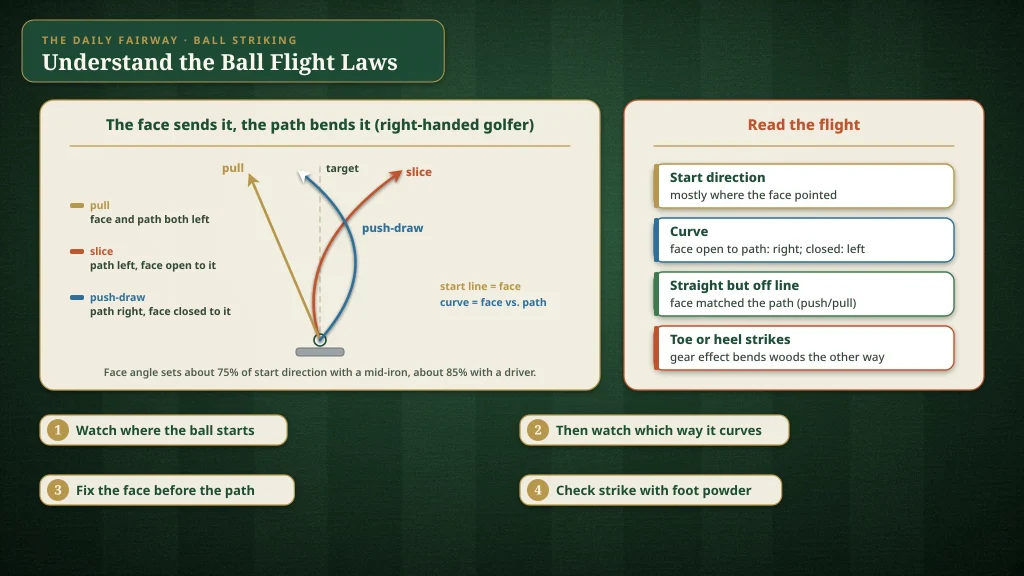
Every curve, push and pull you hit comes down to two things at impact: where the clubface points and which way the club is moving. Once you know how they work together, you can look at any shot and tell what happened. Instructors and launch monitor companies such as TrackMan sum it up in one line: the face sends it, the path bends it. All directions below are for a right-handed golfer.
🛒 Gear that helps with this: Alignment Sticks (2-pack) — The cheapest, most useful practice tool in golf: check aim, ball position and gate drills.
How to do it
1. Face angle sets the start direction. Face angle is where the clubface points at impact, compared with your target line. The ball starts close to where the face points. TrackMan data shows face angle accounts for about 75 percent of the starting direction with a mid-iron and about 85 percent with a driver. Path supplies the rest. So if your ball starts right of the target, the face was almost certainly open to the target at impact.
2. Club path sets the curve, relative to the face. Club path is the direction the clubhead is moving at impact. What makes the ball curve is the difference between face and path, called face-to-path. If the face is open to the path, the ball curves right. If it’s closed to the path, it curves left. If they match, the ball flies straight in whatever direction it started, even if that’s well off target. That’s how you get a straight push or pull. Titleist’s Learning Lab puts it in numbers: for every 5 degrees of spin-axis tilt, the ball curves about 3.5 extra yards per 100 yards of carry.
3. Read your shots from the flight. A slice that starts left and curves well right means the path was out-to-in and the face was open to it. A pull that flies straight left means face and path both pointed left. A push-draw starts right and curves back, from an in-to-out path with the face closed to it but still open to the target. A hook that starts right and curves far left means the face was closed well past an in-to-out path. Start direction tells you about the face. The amount and direction of the curve tells you face-to-path.
4. Fix the face first. Because the face controls most of the start direction, fix where the ball starts before you rebuild your path. Check your grip and clubface at address, since an aim or grip problem shows up first in face angle. Then work on path. Golfers who slice often swing more and more to the left to keep the ball in play, which only makes the curve bigger.
🛒 Many golfers practice this with SKLZ Gold Flex Swing Trainer — A weighted, flexible shaft that punishes a rushed transition and builds smooth tempo.
5. Off-center hits change the rules a little. With a driver or fairway wood, a strike toward the toe tends to curve the ball left and a heel strike tends to curve it right, through what’s called gear effect. If your misses don’t match what face and path suggest, spray the face with foot powder and check where you’re making contact. Low-lofted clubs also curve more for the same face-to-path, which is why your driver slices more than your wedges.
6. Practice with a gate. Push two alignment sticks into the ground about 10 feet ahead of the ball, a few feet apart and centered on your target line. Hit 7-iron shots and note where each ball starts and which way it curves. Then try to start one inside the gate and curve it right, then start one and curve it left. If you have access to a launch monitor, check face angle, club path and face-to-path after each shot, and you’ll see the ball flight laws in your own swing.
Check it yourself: Hit ten shots and write down the start direction and curve of each. Use the patterns above to label each one, such as face open or path out-to-in. In a few minutes you’ll know whether your main problem is the face or the path, and what to work on first.
Top picks for this tip
- 1
Alignment Sticks (2-pack)
Training Aids
The cheapest, most useful practice tool in golf: check aim, ball position and gate drills.
- 2
SKLZ Gold Flex Swing Trainer
Training Aids
A weighted, flexible shaft that punishes a rushed transition and builds smooth tempo.
- 3
Rukket Haack Practice Net
Training Aids
A backyard hitting net for full swings, so you can groove a move between range visits.
Watch it
Face Sends It, Path Bends It – The Golf Ball Flight Laws Explained | Learning Lab | Titleist — Titleist
Sources & further reading
- The Physics of Ball Striking · Titleist
Face sends it, path bends it: face angle accounts for about 75% of start direction with mid-irons and about 85% with the driver, so train face control first. - What is Face-to-Path? · TrackMan
Face to Path is face angle minus club path; with centered contact the ball curves toward the face and away from the path, and zero means no curve. - The Ultimate Guide to Understanding Trackman · TrackMan
Definitions of face angle, club path, spin axis and other launch monitor numbers, measured relative to the target line.
FAQ
What is the "Understand the Ball Flight Laws" golf tip about?
Every curve, push and pull you hit comes down to two things at impact: where the clubface points and which way the club is moving. Once you know how they work together, you can look at any shot and tell what happened. Instructors and launch monitor companies such as TrackMan sum it up in one line: the face sends it, the path bends it. All directions below are for a right-handed golfer.
How do I put it into practice?
Face angle sets the start direction. Face angle is where the clubface points at impact, compared with your target line. The ball starts close to where the face points. TrackMan data shows face angle accounts for about 75 percent of the starting direction with a mid-iron and about 85 percent with a driver. Path supplies the rest. So if your ball starts right of the target, the face was almost certainly open to the target at impact.
What’s the key takeaway?
Check it yourself: Hit ten shots and write down the start direction and curve of each. Use the patterns above to label each one, such as face open or path out-to-in. In a few minutes you’ll know whether your main problem is the face or the path, and what to work on first.
Ready to practice this? Our top pick for this tip is the Alignment Sticks (2-pack).
