 The Daily
Use Strokes Gained to Practice Smarter
Disclosure: Some links on this page are affiliate links. If you buy through them we may earn a commission at no extra cost to you. As an Amazon Associate I earn from qualifying purchases. Learn more.
Most golfers practice what they enjoy, not what actually costs them shots. Strokes gained, the stat golf analytics expert Mark Broadie developed and the PGA Tour now uses, measures every shot against what a benchmark player would need to hole out from the same spot. It shows you exactly where your strokes go, so your practice time goes where it pays off.
🛒 Gear that helps with this: Alignment Sticks (2-pack) — The cheapest, most useful practice tool in golf: check aim, ball position and gate drills.
How to do it
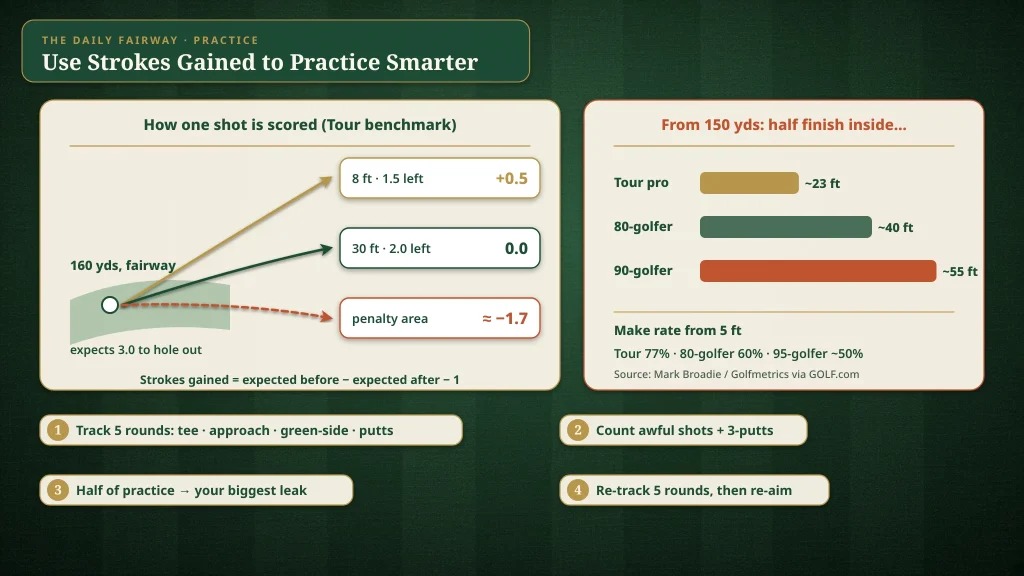
1. Understand the math. Every spot on the course has an expected number of strokes to finish. A Tour player 160 yards out in the fairway averages about three; from 30 feet on the green, about two; from eight feet, about 1.5. Hit that approach to 30 feet and you gained nothing, because one stroke moved you exactly one stroke closer. Stick it to eight feet and you gained half a stroke. Hit an approach into a penalty area and you lose about 1.7. Every shot earns a plus or a minus, and the total explains your score.
2. Track five rounds by category. You don’t need Tour data to use the idea. Sort every shot into four buckets: off the tee, approach shots, around the green, and putting. Note penalties, "awful" shots (chunked chips, balls left in a bunker, approaches into hazards), three-putts, and every putt from 3 to 10 feet, made or missed. A stats or GPS app that calculates strokes gained will do the math for you; a notes column on the scorecard works too.
3. Know where amateurs usually leak. Broadie’s amateur data points to approach shots first. From 150 yards in the fairway, Tour pros hit half their shots within about 23 feet, 80-golfers to around 40 feet and 90-golfers to around 55 feet. Golfers who shoot 90 lose about 3.3 shots a round to awful approach shots, compared with 1.4 for golfers who shoot 80. Distance matters too: 20 more yards off the tee at the same accuracy is worth about 1.8 strokes for a mid-90s player. On the greens, most of the gains are from 3 to 10 feet. From five feet, 95-golfers make about half, compared with 60 percent for 80-golfers.
🛒 Many golfers practice this with PuttOut Pressure Putt Trainer — A compact target that only keeps putts hit at the right speed. Great for the ladder and lag drills.
4. Set realistic targets. Don’t burn hours trying to make half your 10-footers; Tour pros make only about 40 percent of them. Better goals are cutting your average proximity from 150 yards by five feet, trimming one awful short-game shot a round (90-golfers average about two, 80-golfers about one), getting every greenside shot onto the putting surface in one, and holing more five-footers.
5. Let the numbers set the schedule. Give the most practice time to the bucket where you lose the most, which for many amateurs is approaches around 150 yards. Improving with your 150-yard club tends to carry over to the clubs on either side of it. Keep putting time split between 3-to-10-footers and lag putts that leave you inside that range, and avoid spending long sessions on rare shots like 60-yard bunker shots.
Practice plan: Track your next five rounds in the four buckets and circle the one with the most lost shots and awful shots. For the next two weeks, give that bucket half of every session. On the range, hit 20 balls with your 150-yard club and score each one by whether it would finish inside 40 feet, then tighten the circle as you improve. On the green, hit 30 five-footers from around the hole and log your make rate. Re-track five more rounds and let the new numbers pick your next focus.
Top picks for this tip
- 1
Alignment Sticks (2-pack)
Training Aids
The cheapest, most useful practice tool in golf: check aim, ball position and gate drills.
- 2
PuttOut Pressure Putt Trainer
Training Aids
A compact target that only keeps putts hit at the right speed. Great for the ladder and lag drills.
- 3
Odyssey White Hot Putter
Clubs
A classic soft-feel insert putter that’s helped countless golfers with distance control.
Watch it
Strokes gained with "Godfather of Golf Analytics" | Golf Channel — Golf Channel
Sources & further reading
- Why strokes gained is the most important statistic in golf · GOLF.com
How strokes gained works: expected strokes to hole out from each spot, with a worked 160-yard approach example and the cost of finding a penalty area. - What weekend golfers should focus on to save strokes, according to our analytics expert · GOLF.com
Mark Broadie’s amateur data: proximity from 150 yards by scoring level, the value of 20 extra yards off the tee, and make rates from five feet. - The smart-player’s guide to dropping 10 shots · GOLF.com
Mark Broadie: approach shots separate 80- and 90-golfers the most; cut awful shots first, then improve proximity.
FAQ
What is the "Use Strokes Gained to Practice Smarter" golf tip about?
Most golfers practice what they enjoy, not what actually costs them shots. Strokes gained, the stat golf analytics expert Mark Broadie developed and the PGA Tour now uses, measures every shot against what a benchmark player would need to hole out from the same spot. It shows you exactly where your strokes go, so your practice time goes where it pays off.
How do I put it into practice?
Understand the math. Every spot on the course has an expected number of strokes to finish. A Tour player 160 yards out in the fairway averages about three; from 30 feet on the green, about two; from eight feet, about 1.5. Hit that approach to 30 feet and you gained nothing, because one stroke moved you exactly one stroke closer. Stick it to eight feet and you gained half a stroke. Hit an approach into a penalty area and you lose about 1.7. Every shot earns a plus or a minus, and the total explains your score.
What’s the key takeaway?
Practice plan: Track your next five rounds in the four buckets and circle the one with the most lost shots and awful shots. For the next two weeks, give that bucket half of every session. On the range, hit 20 balls with your 150-yard club and score each one by whether it would finish inside 40 feet, then tighten the circle as you improve. On the green, hit 30 five-footers from around the hole and log your make rate. Re-track five more rounds and let the new numbers pick your next focus.
Ready to practice this? Our top pick for this tip is the Alignment Sticks (2-pack).
