 The Daily
Ball Striking
 Quick · 1 min Ball Striking
Stop Hitting the Ball Off the Toe
A toe strike feels dead and stingy in your hands, the ball comes off weak and low, and it often curves the wrong way. The good news is that toe hits usually come from a short list of causes: standing too far away, arms that pull in through impact or an out-to-in path. Find yours, then use the drills below to train centered contact (written for a right-handed golfer).
 Quick · 1 min Ball Striking
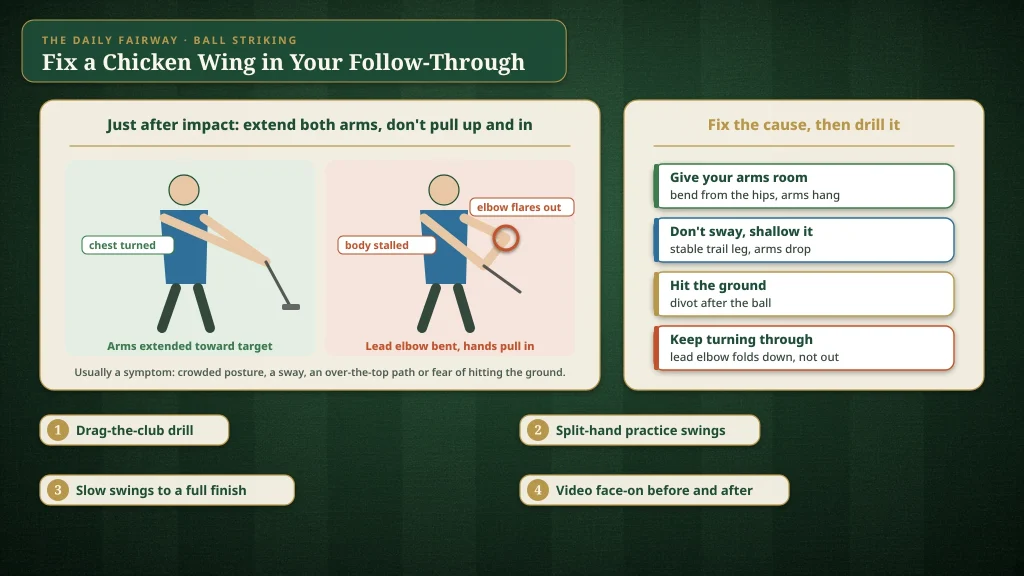
Fix a Chicken Wing in Your Follow-Through
A chicken wing is when your lead elbow (the left elbow for right-handed golfers) bends and flares out away from your body through impact and into the follow-through. Instead of your arms extending toward the target, your elbow points at the target and your arms pull up and in. It often leads to thin shots, weak slices and a loss of distance. The good news is that a chicken wing is usually a symptom of something earlier in the swing. Once you find the cause, you can fix it. Here's a step-by-step plan (written for a right-handed golfer).
 Quick · 1 min Ball Striking
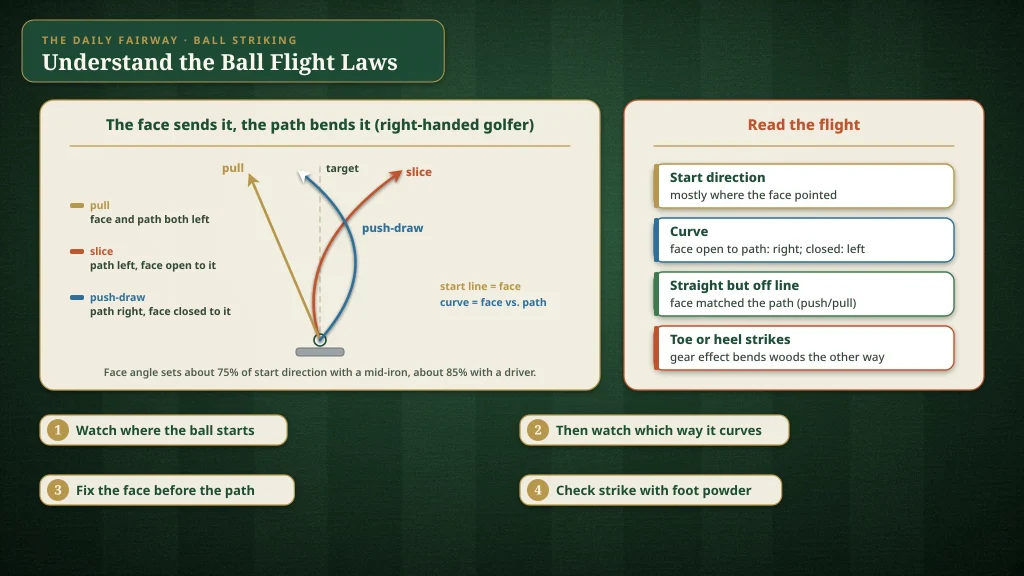
Understand the Ball Flight Laws
Every curve, push and pull you hit comes down to two things at impact: where the clubface points and which way the club is moving. Once you know how they work together, you can look at any shot and tell what happened. Instructors and launch monitor companies such as TrackMan sum it up in one line: the face sends it, the path bends it. All directions below are for a right-handed golfer.
 Quick · 1 min Ball Striking
Stop Swaying Off the Ball
A sway is a slide, not a turn. As you swing back, your hips drift away from the target, past your trail foot, instead of rotating. It often comes from a well-meant idea: 'shift your weight to your back foot.' The problem is that every inch you slide back is an inch you have to slide forward again before impact, in a fraction of a second. Miss that timing and the low point of your swing moves behind the ball, so you hit it fat or thin. Teachers also link the sway to weak slices, lost power and poor balance, and to early extension, where the hips push toward the ball on the way down. The fix is to turn around a stable center so pressure moves into your trail side without your body going with it.
 Medium · 3 min Ball Striking
Stop Hanging Back on Iron Shots
Hanging back means your pressure stays on the trail foot through impact. The low point of the swing stays behind the ball, so you catch it fat, thin, or both — and often flip the hands to rescue contact.
 Medium · 3 min Ball Striking
Stop Casting to Create Lag
Casting means you throw the clubhead early from the top, losing the wrist angle that creates lag. It feels powerful, but the club reaches peak speed too soon and you lose both distance and face control.
 In-Depth · 10 min Ball Striking
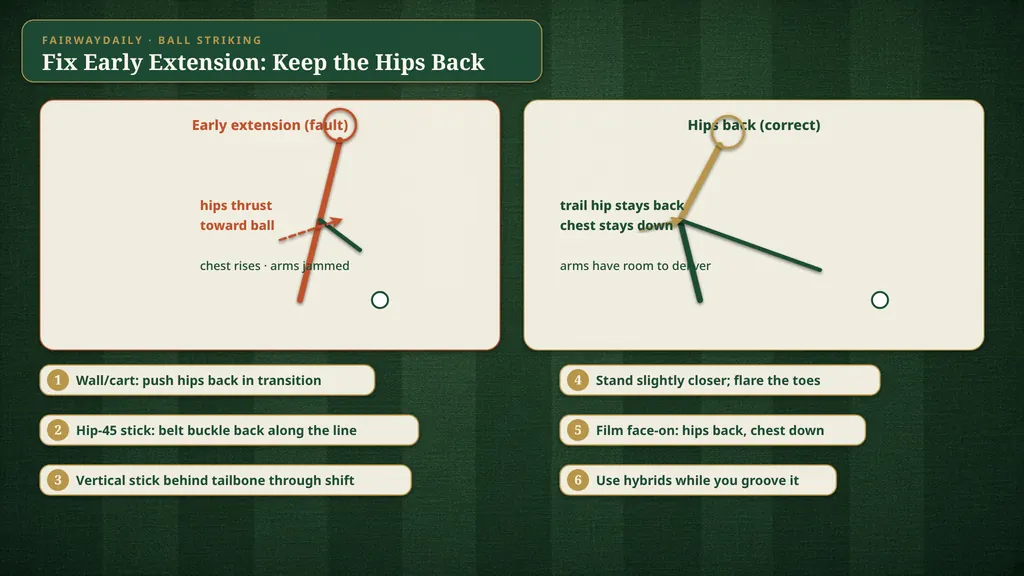
Fix Early Extension
Early extension is when your pelvis thrusts toward the ball in the downswing and your chest rises. That crowds the arms, stalls rotation and leaves you flipping with the hands. The usual result is a two-way miss: pulls and blocks, plus thin and fat contact.
 Medium · 3 min Ball Striking
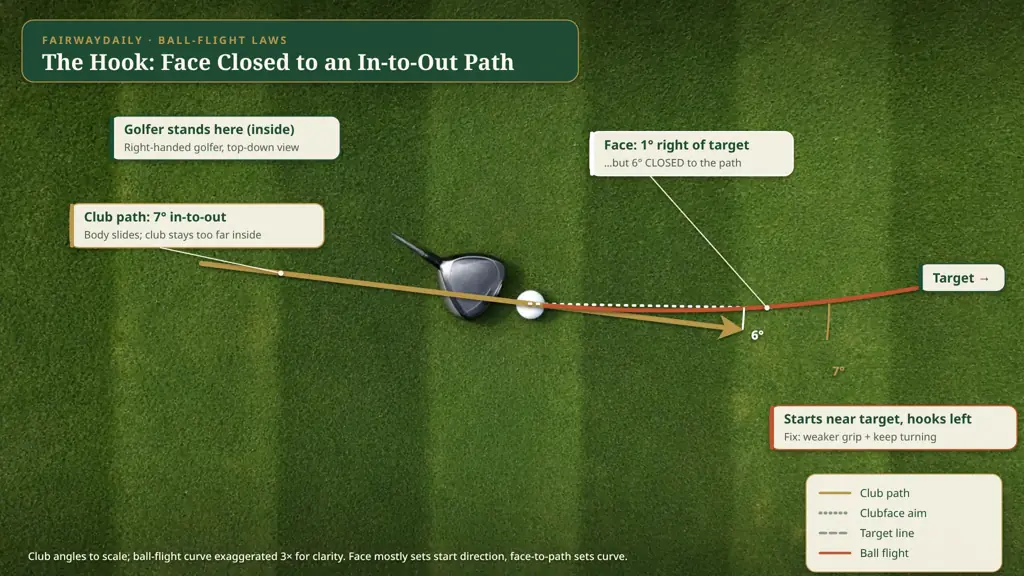
Fix a Hook
A hook comes from a clubface that is closed to a path that is too far in-to-out.
 In-Depth · 10 min Ball Striking
Stop Topping the Ball
A topped shot means the club reached its low point before the ball and was rising when it hit the top of it.
 In-Depth · 10 min Ball Striking
Cure the Shanks
A shank hits the hosel and shoots the ball sharply right. It usually comes from a wide-open face and an out-to-in path, which moves the hosel toward the ball.