 The Daily
Putting
 Quick · 1 min Putting
Feel the Slope With Your Feet to Read Putts
Your eyes can fool you on the green, especially on long, subtle putts. Your feet are better judges of slope. The popular AimPoint green-reading method, used by tour players such as Adam Scott, Collin Morikawa, Viktor Hovland and Justin Rose, starts by feeling the tilt of the green through your feet, then turns that feel into a simple aim point. Here's the basic idea you can try on your next practice round.
 Quick · 1 min Putting
Make More Short Putts With the Clock Drill
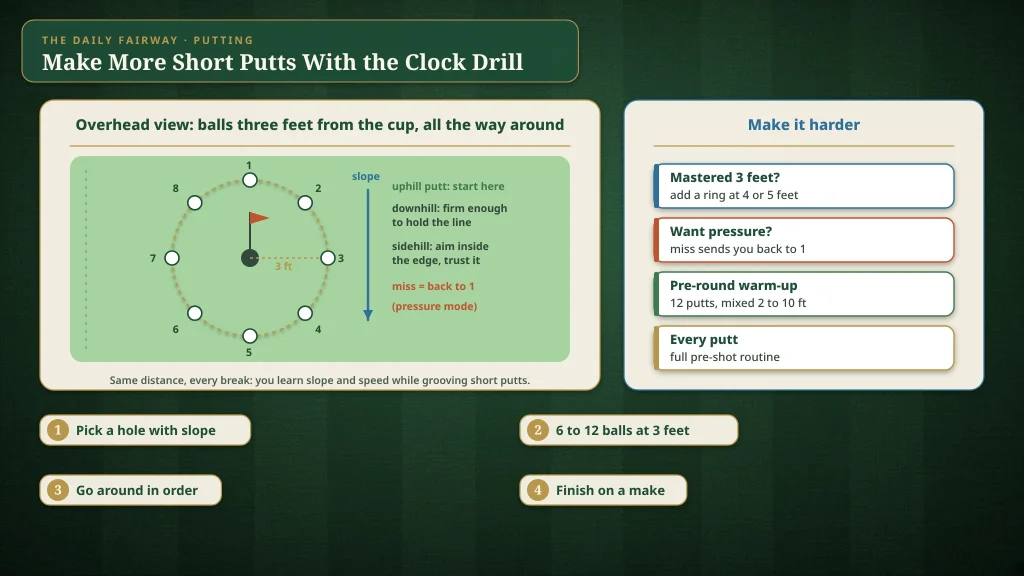
Short putts decide more scores than any other shot, and the classic clock drill is how tour players groove them. You place balls in a circle around the hole and putt them in one by one, so you face uphill, downhill and both sidehill breaks from the same distance. Here's how to set it up and make it count.
 Quick · 1 min Putting
Overcome the Putting Yips
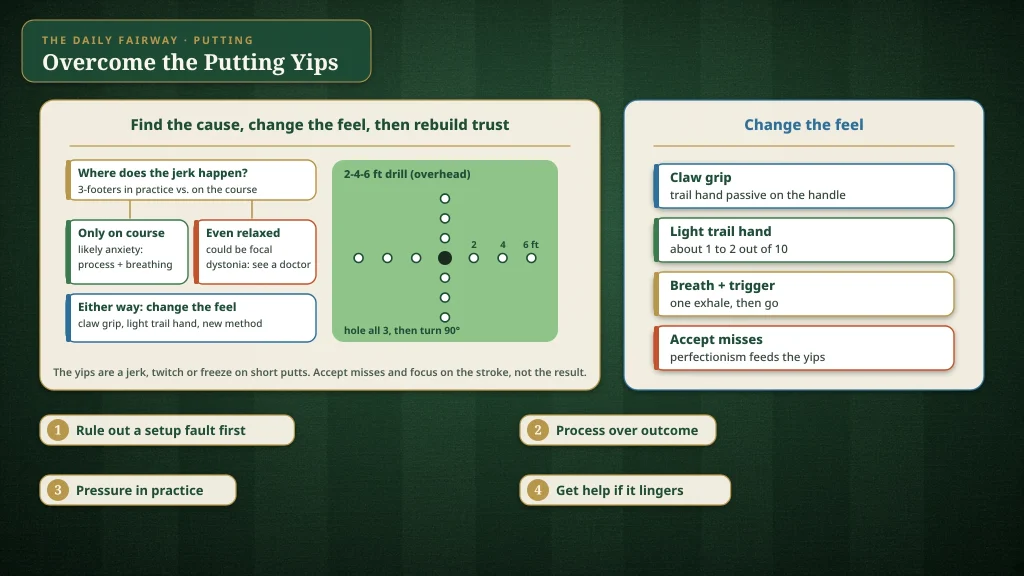
The yips are one of the scariest things in golf: a sudden jerk, twitch or freeze in your stroke, usually on putts you should make. Mayo Clinic describes them as uncontrolled movements of the wrist or hand, and they're more common in older golfers, players who've played for many years and those who play in tournaments. The good news is that most golfers can get past them with the right plan. Here's how to work through it (written for a right-handed golfer).
 Quick · 1 min Putting
Control Your Speed on Fast Downhill Putts
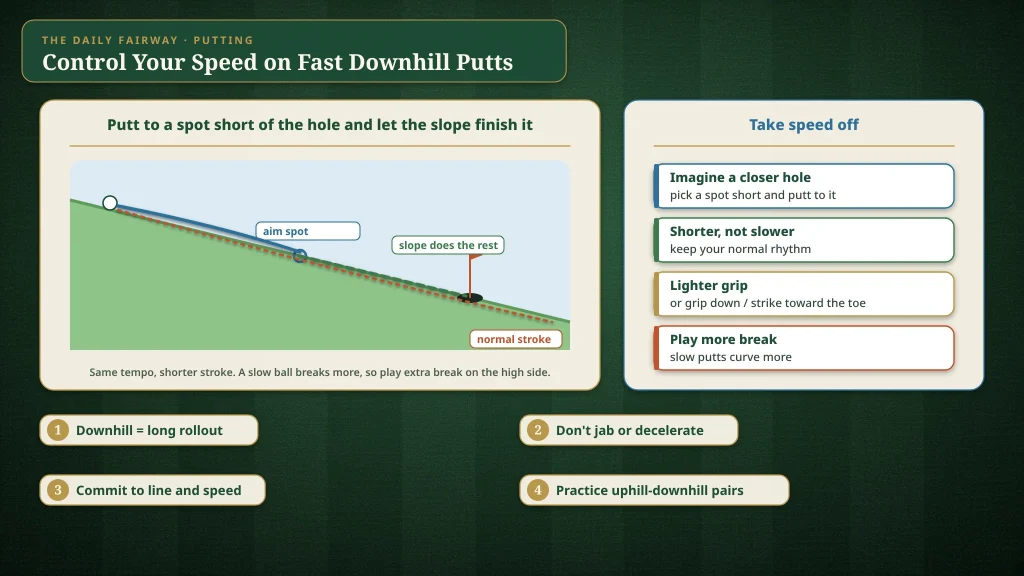
A fast downhill putt is where three-putts are born. The ball keeps rolling long after it would stop on a flat putt, so a normal stroke sends it well past the hole and leaves a tough comebacker. You don't need a new stroke, just a few adjustments that take speed off the ball (written for a right-handed golfer).
 Quick · 1 min Putting
Putt With Your Eyes Closed to Build Feel for Speed
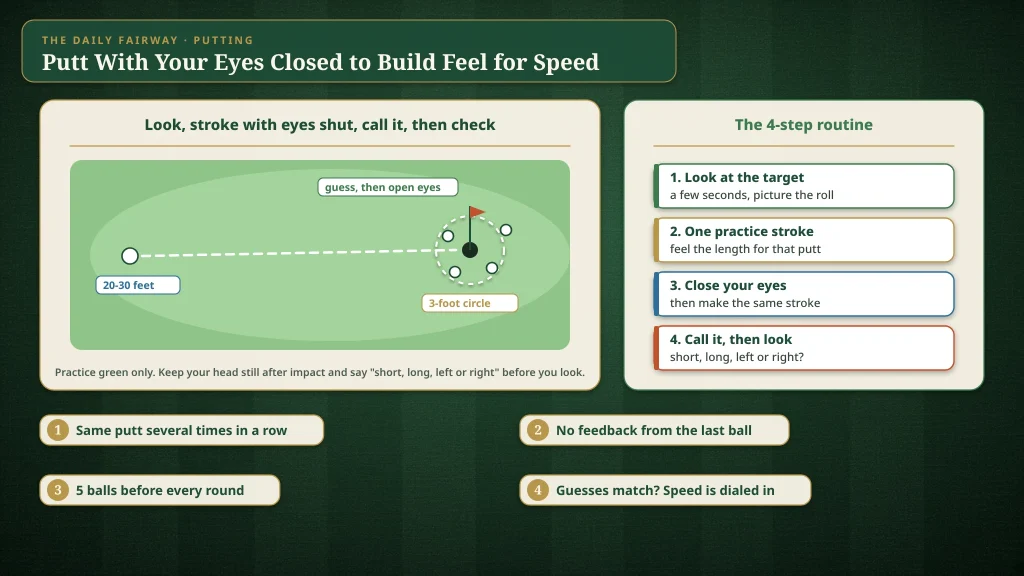
Most three-putts come from bad speed, not a bad read. A simple way to sharpen your feel for distance is to hit a few practice putts with your eyes closed. It sounds strange, but taking away your eyes forces you to pay attention to how the stroke feels. On the practice green, pick a hole or a spot about 20 to 30 feet away. Look at it for a few seconds, make one practice stroke while you picture the ball rolling there, then set up, close your eyes and make your stroke. Keep your eyes shut and your head still after the ball is gone, and say out loud where you think it finished: short, long, left or right. Then open your eyes and check. GOLF Top 100 Teacher Jon Tattersall uses a version of this as a calibration drill, hitting the same putt several times in a row without looking, so you're judging by feel alone. Padraig Harrington recommends a couple of eyes-closed putts before every round, and says it helps nervous putters because you can't react to the putter head. Try five balls before your next round. When your guesses start matching where the ball really stopped, your feel for speed is dialed in.
 Quick · 1 min Putting
Read a Double-Breaking Putt in Two Parts
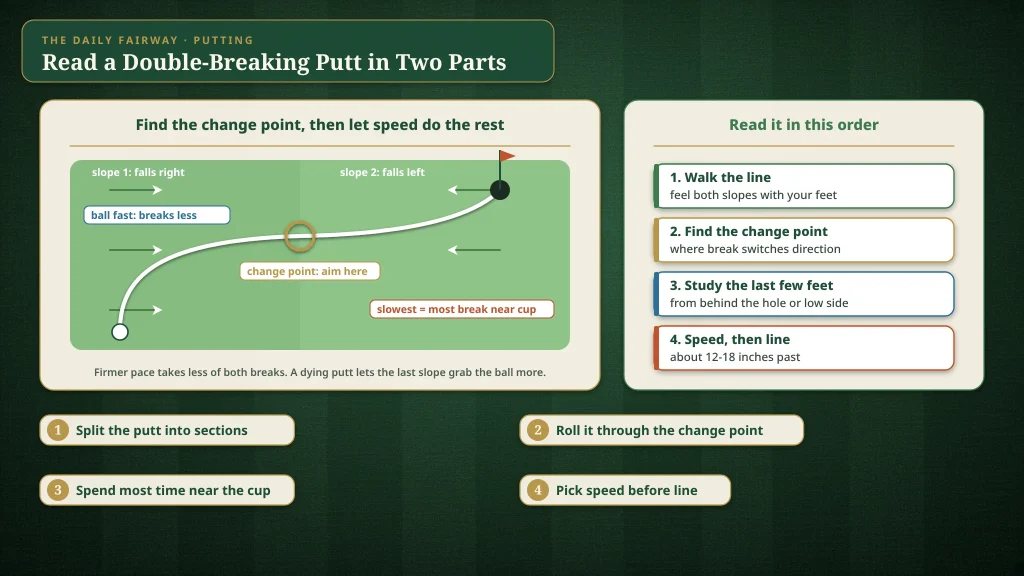
A double-breaking putt curves one way and then the other, like a long putt that starts moving left to right and finishes right to left near the hole. Most golfers try to picture one big S-shaped line from behind the ball and end up guessing. A better plan is to split the putt into pieces, find the spot where the break changes direction and remember that speed changes everything. Here's how (written for a right-handed golfer).
 Quick · 1 min Putting
Read the Grain on Bermuda Greens
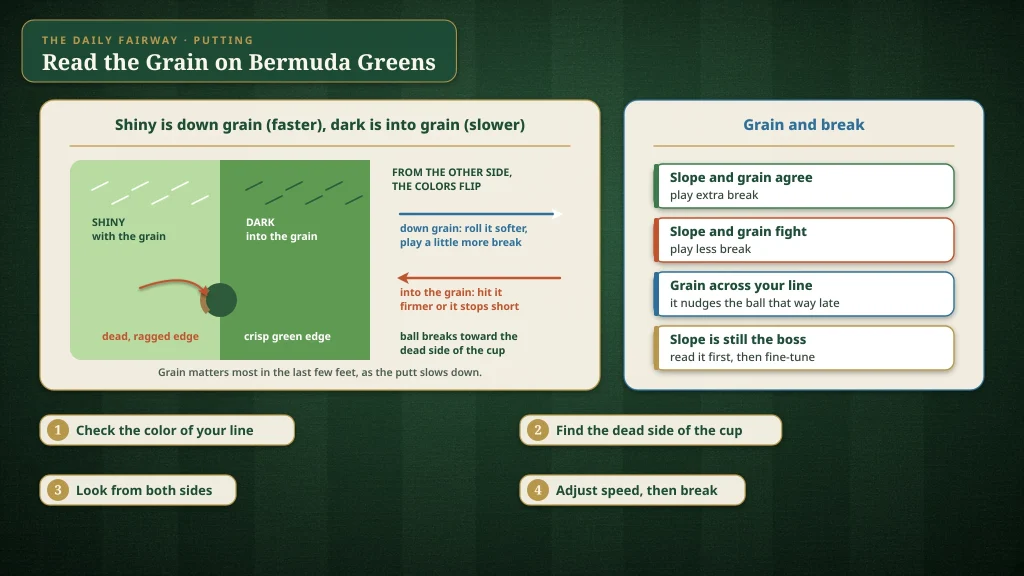
If you play in the South or on vacation in Florida, Arizona or Myrtle Beach, you'll putt on Bermudagrass. Its blades grow sideways as well as up, and that lean, called grain, changes how fast the ball rolls and how much it breaks. Putts roll faster down the grain and slower into it, and grain that runs across your line can nudge the ball sideways. Here's how to read it in a few seconds.
 Quick · 1 min Putting
Roll Your Putt Over a Spot
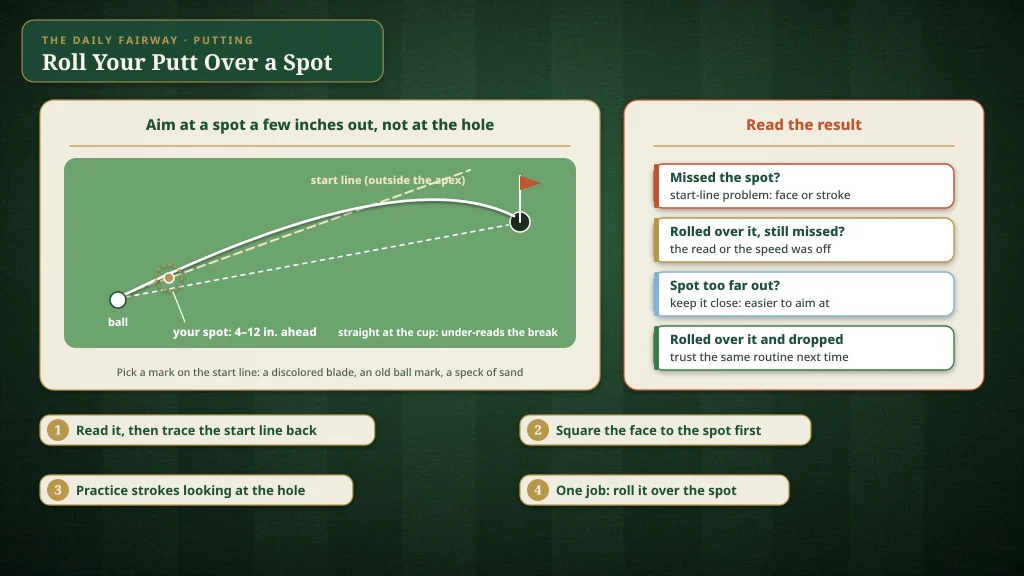
It's much easier to aim at something a few inches away than at a hole 20 feet away, which is why so many good putters are "spot putters." Once you've read the putt, stand behind the ball and trace your start line back to the ball. On a breaking putt that's the line the ball starts on, outside the apex, not a line straight at the cup. Pick a small mark on that line about 4 to 12 inches in front of the ball: a discolored blade of grass, an old ball mark or a speck of sand. Square the putter face to that spot first, then build your stance around it, the same clubface-first order GOLF Top 100 Teacher Jim Murphy teaches for aiming any club. Make your practice strokes looking at the hole to feel the speed, then set up and give yourself one job: roll the ball over the spot. Keep the spot close; as Murphy puts it, the closer the target, the easier it is to aim at. If the ball misses your spot, work on your start line. If it rolls over the spot and still misses, the read or the speed was off.
 Quick · 1 min Putting
Flagstick In or Out? Let Your Speed Decide
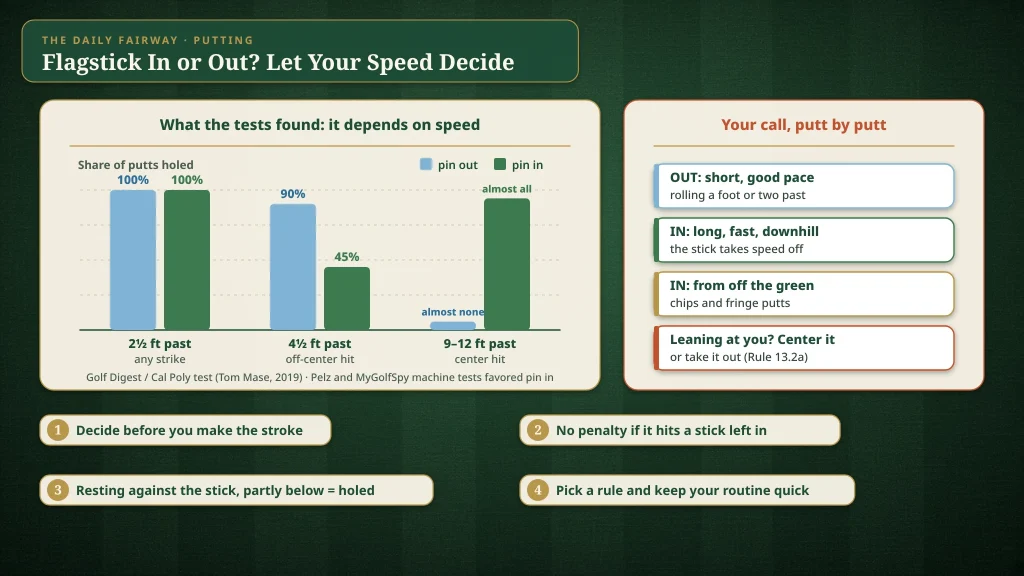
Since 2019 the Rules have let you putt with the flagstick in without penalty, and golfers still argue about whether it helps. The research doesn't fully agree either. Dave Pelz's machine tests, first run in 1990, and a later MyGolfSpy machine test both found that leaving the stick in holed more putts, because a fiberglass flagstick soaks up speed and lets gravity pull the ball down. A 2019 Golf Digest test by Cal Poly engineering professor Tom Mase found the opposite for putts that clip the stick off-center at a normal pace. The difference comes down to how fast the ball is rolling and where it hits the pin, so make the call shot by shot.
 Quick · 1 min Putting
Use a Line on Your Ball
Draw a line on your ball and aim it at your start line on short putts. Test 10 putts with it and 10 without; keep it only if it helps you commit.